Luke Newton as Colin Bridgerton and Nicola Coughlan as Penelope Bridgerton in
Bridgerton season four.
In Quinn’s Bridgerton books, Daphne, Anthony, Benedict, and Francesca are all married before Colin. In Bridgerton the Netflix show, however, Colin and Penelope’s love story takes place before Benedict and Sophie’s. “I felt like it was a great decision to sort of swap the order of the books,” Luke Newton, who plays Colin, told Town & Country. “I feel like there would’ve been a level of frustration if we had another season of Colin just not seeing what’s right in front of him. I feel like in the end, fans wouldn’t be on his side. They’d be like, ‘bro, you missed your chance. You are out. She needs to move on.’”
Therefore, the timelines get a bit wonky in the show: Penelope and Colin marry before Benedict, as do Francesca and John. In the book, there are a number of references to Benedict and Colin being single, and Francesca also being unwed. Those are all dropped in season four in favor of storylines about their marriages. In addition, since Penelope and Colin’s story was in season three, the revelation of Lady Whistledown’s true identity has already happened, but in An Offer from a Gentleman, she remains a mystery.
3. Some masquerade ball costumes
Netflix
From left to right: Michelle Mao as Rosamund Li, Katie Leung as Lady Araminta Gao, Isabella Wei as Posy Li.
The big set piece of the first part of season four takes place in the premiere episode, at Violet Bridgerton’s masquerade ball. Quinn describes a few characters’ costumes in the book. Some costumes do remain the same, including Eloise as Joan of Arc, Posy as a mermaid, and Rosamund as Marie Antoinette. However, many were changed for the show. In the book, Lady Araminta goes as Queen Elizabeth and Penelope is a leprechaun, but in the Netflix series, Araminta appears in a dramatic black gown, while Penelope is a pirate.
4. The glove and Benedict’s search for Sophie
While much of Sophie and Benedict’s first meeting, first dance, and her midnight departure from the ball plays out as it does in the book, the glove Sophie leaves behind is slightly different. In the book, her gloves feature the Penwood crest and her grandmother’s monogram featuring the initials ‘SLG’ (for Sarah Louisa Gunningworth). In the show, those details are not clear. Similarly, Benedict’s search for Sophie in the books is depicted as more straightforward —he asks his mother for help identifying the crest, and then goes to meet Posy and Rosamund. In the series, he and Eloise scheme to find the identity of the glove’s owner.
5. The timeline of Benedict and Sophie’s romance
Netflix
Benedict and Sophie’s first meeting.
In An Offer from a Gentleman, two years pass between the masquerade ball and when Benedict and Sophie cross paths again. That timeline is compressed in the show; it’s unclear how much time has elapsed between their meetings but it is implied to be much shorter.
6. The attempted rape scene
In Quinn’s novel, Sophie is working in Lord and Lady Cavender’s household when three men attempt to rape her at a party before Benedict intervenes. She is actually attempting to flee the house when the Cavenders’ son, Phillip, stops her with his friends. “Sophie cried out as she was propelled forward, and she clutched tightly to her small bag. She was about to be raped; that much was clear. But her panicked mind wanted to hold on to some last shred of dignity, and she refused to allow these men to spill her every last belonging onto the cold ground,” Quinn writes. Benedict’s reaction is more subdued in the book than we see in the show, but still intense: He doesn’t fight Phillip, but pressures him to let Sophie go.
In the series, Benedict sees three men attempt to assault Hazel, Sophie’s friend with a limb difference. Sophie intercedes, splashing their faces with water, telling Hazel, “Run. Lock yourself in your room.” When Phillip Cavender then calls Sophie a bitch, she says, “I shall scream if you touch me,” to which he replies, “Oh, we do like it when they scream.” Benedict hears that, comes running, and punches Cavender, screaming at him to apologize to her. Sophie runs away as the men fight, but trips and falls, so she witnesses the exchange.
7. Benedict’s illness in the book vs. Benedict’s injury in the series
Because of the change in plot in how Benedict helps Sophie get away from Cavender, what causes Benedict to be out of commission at My Cottage changes. In the book, he falls ill with a fever after driving in the rain; in the show, he is hurt from the fight. (Though it does also rain in the series.)
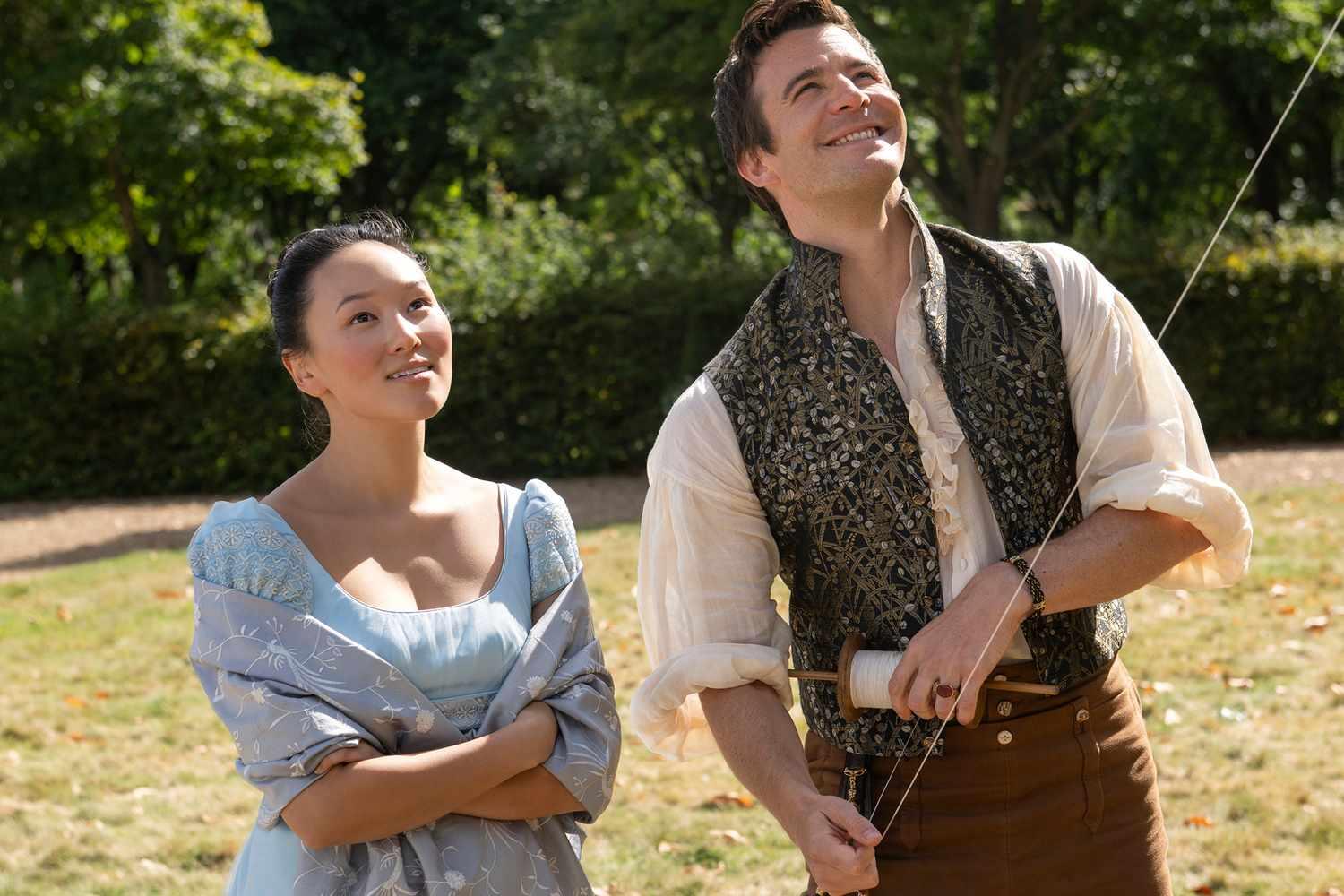
8. The kite scene
Netflix
Ha and Thompson filmed the kite scene on their first day working together.
In the show, Benedict and Sophie fly a kite together at My Cottage; that scene does not appear in the books. That moment, Brownell says, symbolizes “the characters’ change, what their arcs are, and what they mean to each other.” The scene focuses on how “Sophie needs to allow herself to dream of joy and Benedict needs to commit to purpose.”
The kite, Thompson says, symbolizes their characters’ journey. “When Benedict is in that romantic vein, there’s just endless choice and endless possibility and endless freedom. It’s actually very difficult to tie him down, which is why actually the kite’s quite a nice symbol, really. It crystallizes their relationship.”
It was actually the first scene Ha and Thompson shot together. Ha says, “The kite scene was a really good parallel of me letting my walls down and being able to trust this person as an actor to actor. It was really sweet. That was the day where I thought, ‘I’m going to be okay for 10 months, or however long this shoot is. We will have each other’s backs.”

Để lại một bình luận