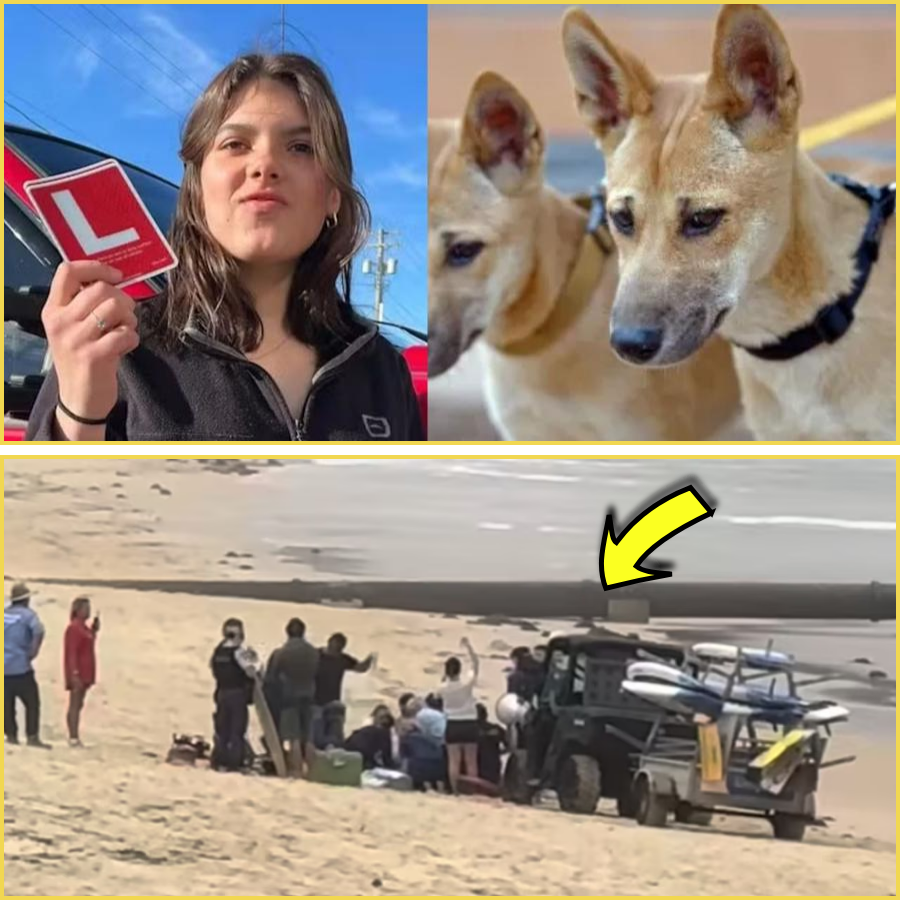
The quote “They were just standing in advantageous positions.” — shared by a regular beachgoer who spoke to police — has introduced yet another layer of mystery to the investigation into the death of 19-year-old Canadian backpacker Piper James on K’gari Island (formerly Fraser Island), Queensland, Australia. According to the witness, a longtime observer of the island’s wildlife, the pack of dingoes (often colloquially called stray dogs) near Piper’s body did not appear to be fighting over food, scavenging chaotically, or displaying overt aggression. Instead, the animals were positioned in a remarkably even, spaced-out formation — roughly equal distances apart — something locals insist they had never witnessed in years of beach patrols and sightings.
“It looked deliberate. As if they knew where to stand.” The beachgoer’s description suggests intentionality: a strategic placement that evoked coordinated positioning rather than random opportunism. This observation, paired with video footage reportedly handed over to authorities, is fueling speculation that the dingoes’ behavior in those critical moments may not align with typical scavenging or dominance-testing patterns documented on K’gari.
The Discovery and Initial Narrative
On January 19, 2026, Piper James — a spirited 19-year-old from Campbell River, British Columbia, who had been volunteering on the island since arriving in Australia the previous October — set out alone around 5 a.m. for an early swim near the iconic SS Maheno shipwreck on 75 Mile Beach. She sought the quiet beauty of sunrise over the ocean, a ritual she loved for its sense of liberation in the wild landscape.
Roughly 90 minutes later, two men driving along the beach encountered a pack of about 10 dingoes encircling an object at the waterline. Closer inspection revealed Piper’s body, and they promptly alerted Queensland Police, who arrived by 6:35 a.m. to confirm the fatality. Initial reports highlighted injuries “consistent with dingo interference,” including bite marks and defensive wounds, leading many to assume a predatory or scavenging attack by the pack.
Autopsy Insights: Drowning Primary, Bites Secondary
The Coroners Court of Queensland’s preliminary autopsy provided a more nuanced picture: evidence “consistent with drowning” (water in the lungs) was present, alongside “injuries consistent with dingo bites.” Ante-mortem (pre-death) bites suggested interaction while she was alive, but these were not deemed immediately fatal. Post-mortem scavenging appeared more pronounced.
This supported drowning — possibly from riptides, exhaustion, disorientation, or struggle in the surf — as the leading cause, with dingoes approaching afterward. Defensive marks implied resistance during initial contact. The case differed markedly from rare confirmed fatal dingo maulings, such as the 2001 incident involving a child.
Piper’s family, including father Todd James, has spoken publicly about her admiration for the dingoes (noting their resemblance to her pet dog at home) but acknowledged warnings against approaching them. Todd speculated that dingoes may have perceived her as vulnerable — perhaps splashing or struggling — and “corralled” her toward deeper water, a behavior some observers link to opportunistic predation tactics.
The Beachgoer’s Account and the “Deliberate” Formation
The regular beachgoer’s statement marks a significant pivot. Unlike frenzied scavenging (common when food is involved) or the “dominance alliance” behaviors recently documented in tourist videos — where dingoes reportedly work in pairs or small groups to test or separate people from belongings — this witness described a calm, almost calculated standoff.
The even spacing — “advantageous positions” — evoked encirclement strategies seen in some wild canid packs during hunts or territorial displays, though experts note dingoes on K’gari typically form loose family units rather than large, highly coordinated hunting parties. Locals familiar with the animals’ habits emphasized that such uniform positioning is anomalous: dingoes usually cluster opportunistically around carrion or scatter when humans approach.
If the footage corroborates this — showing the pack holding stationary, evenly distributed spots around the area — it could challenge assumptions that the dingoes were purely reactive scavengers. Questions arise:
- Did prior events (e.g., Piper in distress in the water) prompt a vigilant, waiting formation?
- Could environmental factors, pack dynamics, or even unreported human activity influence this?
- Does it indicate heightened habituation or learned behavior from tourism pressures?
Related reports have highlighted other recent sightings of dingoes acting “in concert” or “bold and deliberate,” including a family’s video of animals seemingly teaming up near beachgoers. Rangers have attributed such shifts to human-sourced food or proximity, eroding the dingoes’ natural wariness.
Official Actions and Backlash
Queensland’s Department of Environment deemed the pack an “unacceptable public safety risk” after observing continued aggressive behavior post-incident. Environment authorities authorized humane euthanasia, with at least six of the 10 dingoes culled and others targeted. Rangers focused on those linked by location, markings, and behavior.
The decision drew sharp criticism:
- Butchulla Traditional Owners voiced heartbreak over the lack of consultation, underscoring the wongari’s (dingo) cultural and ecological significance.
- Wildlife advocates and experts (including from universities and conservation groups) argued culling is reactive and ineffective long-term, ignoring root causes like illegal feeding, poor visitor education, and high tourism volumes (450,000+ annually).
- Piper’s family opposed the measure, noting it contradicted her love for nature and the animals.
Broader management debates intensified: dingoes remain genetically pure apex predators vital to the ecosystem, yet habituation risks rise with visitor numbers. Negative encounters stay rare, but education (no feeding, distance, supervision) remains key.
Implications of the New Footage and Witness Testimony
As the coronial inquest proceeds — with full pathology and behavioral analysis pending — the beachgoer’s description and associated video could prove decisive. If visuals confirm the “deliberate” spacing and lack of aggression/scavenging frenzy, it might:
- Reinforce drowning as primary, with dingoes in a watchful rather than attacking role.
- Prompt deeper probes into pack psychology, habituation, or external influences.
- Influence future dingo management, emphasizing non-lethal strategies like deterrents and education.
For now, speculation is tempered: police hold the material, and authorities caution against premature conclusions. Piper’s loved ones plan a visit to honor her bond with K’gari’s untamed beauty.
The tragedy underscores the island’s duality — paradise where nature’s rhythms can turn perilous in an instant.
Để lại một bình luận