
My grandfather, Robert Hayes, passed away quietly at eighty-seven. He was a self-made man—stern, principled, and respected by everyone who had ever done business with him. He built an empire from nothing, brick by brick, deal by deal. To the outside world, he was a legend.
To me, he was simply Grandpa.
What shocked the family wasn’t his death.
It was the fact that he left no will.
No instructions.
No inheritance plan.
No final wishes written in ink.
Just silence.
At the lawyer’s office, the air felt thick and heavy. My father, Michael Hayes, sat at the head of the long oak table like a king already wearing his crown. My older brother, Brandon, leaned back in his chair, arms crossed, a smug half-smile on his face.
He already knew how this would end.
I sat quietly near the window, watching dust float through the sunlight, my hands folded in my lap.
The lawyer cleared his throat.
“Without a valid will, the estate will be distributed according to state law.”
That was all my father needed to hear.
As the eldest surviving child of Robert Hayes, he claimed full control—companies, properties, accounts, shares. Within weeks, locks were changed, documents signed, money moved. The empire shifted hands seamlessly… and I was erased from it just as easily.
One night, during a family dinner meant to “honor Grandpa’s memory,” my father finally said it out loud.
He set his glass down, looked directly at me, and sneered.
“You won’t get a single penny. Brandon is the next heir. You’ve always been… temporary.”
Temporary.
The word sliced deeper than any insult.
Brandon smirked, enjoying every second. No one spoke. No one objected. I felt small—like a guest in a family I had never truly belonged to.
Then something happened that no one expected.
My mother, Susan Hayes, stood up.
She had been silent for weeks. Grieving quietly. Watching. Listening.
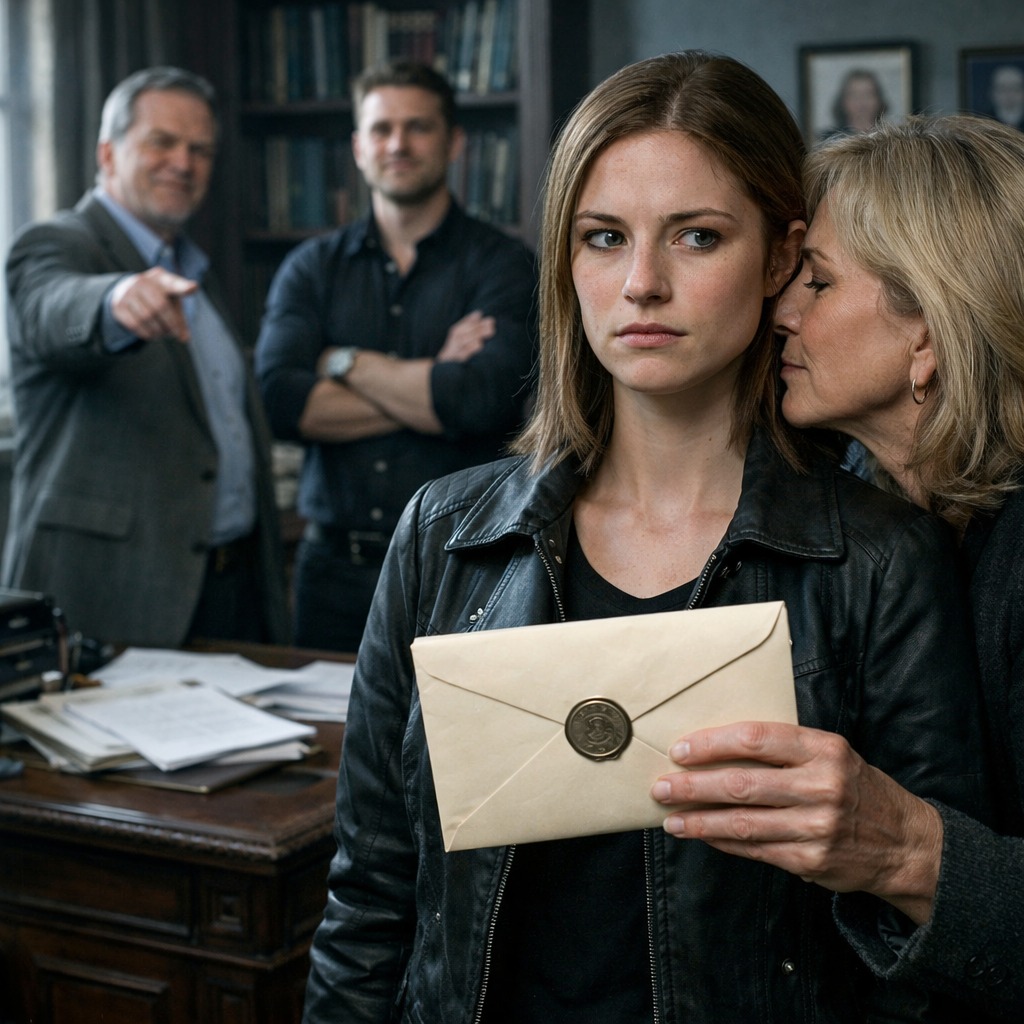
She walked toward me slowly, her hands trembling just slightly. Without looking at my father or my brother, she slipped a thick, sealed envelope into my hand and leaned close.
Her voice was barely above a breath.
“It’s time,” she whispered,
“to let them know who you really are.”
Before I could ask a single question, she turned and walked out of the room.
My father laughed dismissively.
“What’s that? Another lie?”
Brandon rolled his eyes.
I didn’t respond.
That night, alone in my room, I opened the envelope.
Inside were documents.
Medical records.
Legal affidavits.
DNA results.
And a handwritten letter—my grandfather’s unmistakable handwriting.
My heart pounded as I read.
The truth hit me like a wave.
My father wasn’t my biological father.
Robert Hayes was.
Decades earlier, my mother had been forced into silence to protect the family’s reputation. Grandpa knew the truth. He raised me from a distance, guided me quietly, tested my character without ever revealing why he watched me so closely.
The letter ended with one sentence:
“I didn’t leave a will because the truth itself is the inheritance.”
The next morning, I walked back into that same house—but I was no longer temporary.
At the next legal meeting, I placed the documents on the table.
The room went dead silent.
My father’s face drained of color.
Brandon’s smirk vanished.
The lawyer read everything carefully… then looked up.
“Legally,” he said, “this changes everything.”
The empire my father thought he owned outright was suddenly frozen—pending investigation, paternity confirmation, and asset redistribution.
For the first time in my life, they looked at me not as an afterthought…
…but as a threat.
As I stood up to leave, my mother caught my eye. She didn’t smile. She didn’t cry.
She simply nodded.
And in that moment, I understood something my grandfather had known all along:
Power doesn’t always come from money.
Sometimes, it comes from the truth—waiting patiently for the right moment to be spoken.