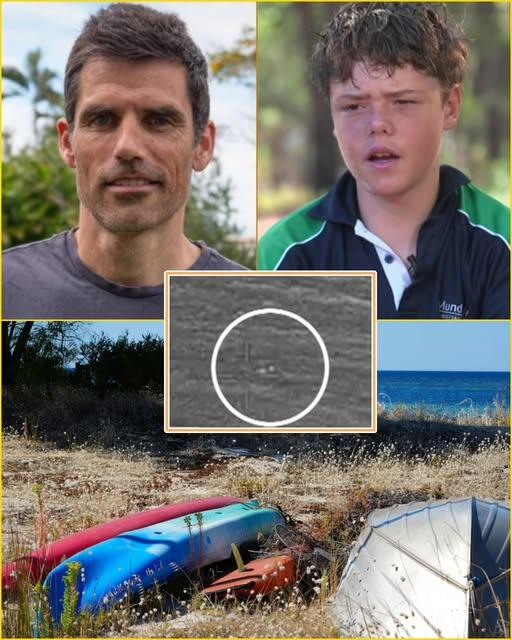
The sun had long set over Geographe Bay when 13-year-old Austin Appelbee finally dragged himself onto the sand near Quindalup, Western Australia. His body was beyond spent—four grueling hours in the open ocean, battling relentless currents and cold water after his family was swept far offshore. He had ditched the leaking kayak, shed his life jacket to move faster, and swum what rescuers later called a “superhuman” 4 kilometers (about 2.5 miles) to shore. Then, without pause, he ran another 2 kilometers along the beach—barefoot, legs burning—to reach his family’s belongings and grab his mother’s phone.
It was around 6 p.m. on January 30, 2026. Darkness was closing in. Austin dialed Triple Zero (000), Australia’s emergency line, and what followed has become one of the most shared audio clips in recent memory.
His voice, captured in the released recording, is eerily steady. No hysteria. No trembling. Just a clear, composed teenager relaying life-or-death details to the operator.
“Hello, my name is Austin and I’m outside the beach,” he begins. “I have two siblings, Beau and Grace. Beau is 12 and Grace is eight.”
He explains the rental gear—a kayak and paddleboards—how sudden rough winds dragged them out to sea. “We got took out to sea and we got lost out there… Mum told me to go back and get help, and then I haven’t seen them since.”
The operator asks questions; Austin answers precisely. He estimates the time elapsed: “a very long time ago.” He describes the family’s position: “kilometres out to sea.” He urges action: “I think we need a helicopter to go find them.” He admits fear: “I don’t know what their condition is right now, and I’m really scared.”
Throughout, his tone remains calm—almost unnervingly so for a boy who had just pushed his body to the brink. He spells his last name carefully: “A-P-P-E-L-B-E-E.” He provides directions, weather details, everything needed to launch a search.
Then, as the call nears its end, the physical toll crashes through. Austin’s breathing grows labored. He tells the operator he’s dizzy, extremely tired. “I think I need an ambulance because I think I have hypothermia.”
He mentions heat stroke symptoms too—confusion in the mix of cold water and exhaustion. And then, in the final moments, come those three words that have left Australia stunned, replaying the clip obsessively across social media, news broadcasts, and podcasts.
“I’m about to pass out.”
Spoken quietly, matter-of-factly, with no drama or plea for sympathy—just an honest admission from a child who had given absolutely everything. The operator responds calmly, keeping him talking, but moments later Austin collapses. Paramedics arrived soon after; he was rushed to hospital, where he later learned the rescue helicopter had located his mother Joanne, 47, brother Beau, 12, and sister Grace, 8, clinging to a single paddleboard some 14 kilometers (nearly 9 miles) offshore after up to 10 hours in the water.
All were treated for hypothermia and released the next day. Austin needed crutches and a wheelchair for days due to severe leg strain—he had barely passed a 350-meter school swim test weeks earlier.
Western Australia Police released portions of the call on February 11, 2026, during the debut of their podcast Operation Podcast, with family permission. The decision highlighted how clear communication aids responders. But the public reaction focused on Austin’s composure—and that closing line.
Social media erupted. “This kid is unreal,” one commenter posted. “Swims 4km in the dark, runs 2km, calls for help like a pro, then casually says he’s about to pass out.” Others called it “chilling” and “profound”—a reminder that true bravery often sounds quiet, not loud.
ABC News, 7 News, SBS, and international outlets like CNN, BBC, and The Guardian aired excerpts. Prime Minister Anthony Albanese praised Austin as an “inspiration.” Rescue commander Paul Bresland labeled the swim “superhuman.” Experts pointed to mental resilience: prayer, family thoughts, childhood stories like Thomas the Tank Engine that kept him going.
Austin himself deflected hero status. “I don’t think I am a hero,” he told the BBC. “I just did what I did.” His mother Joanne described the agonizing decision to send him: “I knew he was the strongest.” She credits faith too—”God got us through it.”
The incident sparked broader discussions on water safety. Swimming Australia urged more ocean education; locals in Quindalup reflected on the bay’s deceptive calm turning deadly fast.
In the audio’s final seconds, those three words—”I’m about to pass out”—capture the essence. Not triumph, but vulnerability after extraordinary sacrifice. Austin had held it together long enough to save his family, then let the truth slip out in the simplest way. No exaggeration. No self-pity. Just a boy’s honest limit, reached only after ensuring others would live.
Australia hasn’t stopped listening. In a culture that celebrates larrikin grit, this story resonates deeper: heroism isn’t always bold declarations. Sometimes it’s a calm voice on a phone, guiding rescuers through the night—followed by three quiet words that say everything.
Để lại một bình luận