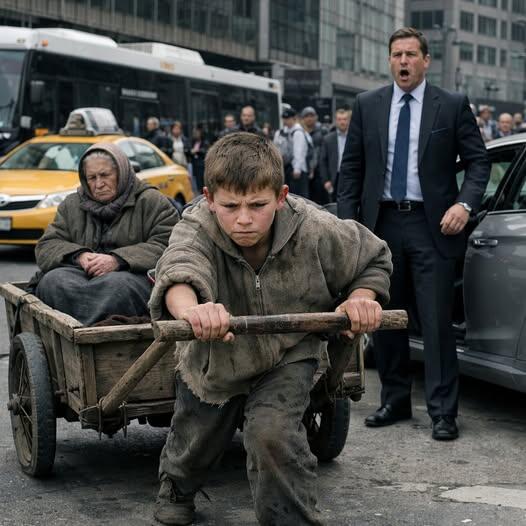
Diego Salazar slammed on the brakes in the middle of Avenida Insurgentes.
Car horns exploded behind him. Drivers shouted. But none of it reached him.
What had stopped Diego wasn’t traffic.
It was a battered metal garbage cart rolling slowly along the sidewalk.
And the woman sitting on top of it.
Wrapped in dirty rags. Hair tangled and gray. Eyes distant, unfocused—like someone already halfway gone from the world.
Diego’s blood turned cold.
“No… no, this can’t be real…”
He jumped out of the car without thinking, leaving the engine running, the door wide open, his tailored suit forgotten. Something deeper than reason pulled him forward.
With every step, dread tightened around his chest.
Then he saw her face clearly.
It was his mother.
Carmen Salazar—missing for nine days. The woman who raised him alone in Iztapalapa after his father died. The woman who scrubbed floors, washed dishes, ironed clothes from dawn until night so her son could study, so he could escape poverty, so he could dream.
The woman Diego promised to protect once he became successful.
And now she sat on a garbage cart—thin, filthy, barely conscious.
Diego’s legs nearly gave out.
A young man pushing the cart froze when Diego reached them. Panic flashed across his face.
Diego grabbed him by the collar, rage exploding from a place deeper than thought.
“What did you do to her?” Diego shouted. “What have you done to my mother?!”
The young man didn’t fight back.
He didn’t even flinch.
He just looked… tired. Hollowed out. Like someone life had already beaten too many times.
“I didn’t hurt her,” he said quietly. “I found her like this. I’ve been taking care of her.”
The words hit Diego harder than a punch.
He released the man and dropped to his knees beside the cart, ignoring the stares of strangers. He took his mother’s hands—cold, trembling, unfamiliar… yet unmistakably hers.
“Mom,” he whispered. “It’s me. Diego. Please… look at me.”
Slowly, she lifted her face.
Diego searched her eyes desperately—for recognition, for warmth, for the sharp love that had guided his entire life.
Instead, he found emptiness.
As if a light inside her had gone out.
His chest shattered.
“Mom…” he tried again, his voice breaking.
For a long moment, she stared at him as if through heavy fog.
Then her lips moved.
“Dieguito…” she whispered. “Is that really you?”
Relief crashed over him so violently he couldn’t stop the tears. They streamed down his face as he clutched her hands.
“Yes, mamá. I’m here. I found you. I’m taking you home.”
Only then did Diego turn back to the young man. His anger was gone—replaced by urgency and shame.
“Please,” Diego said hoarsely. “Tell me how you found her. Tell me what happened.”
The young man introduced himself as Luis.
He was a garbage collector who worked the early morning routes. Nine days earlier, he had found Carmen collapsed near an alley, confused, dehydrated, and clutching a small purse with Diego’s childhood photo inside.
She couldn’t remember where she lived. Only one name.
“Diego.”
Luis tried hospitals. Police stations. Shelters.
No one helped.
So he did what he could.
He gave her water. Bought her food. Wrapped her in blankets. When his supervisor allowed it, he let her sit on the cart so she wouldn’t have to walk.
“I didn’t know what else to do,” Luis said softly. “I couldn’t leave her.”
Diego felt something tear open inside him.
While he had been offering rewards, making phone calls, trusting systems…
A stranger with nothing had kept his mother alive.
Carmen was taken to the hospital that day. Doctors diagnosed her with early-stage dementia and severe dehydration. They said one more night on the street might have killed her.
Diego stayed by her bedside, holding the same hands that once held his when he was small.
And he didn’t forget Luis.
The next morning, Diego returned to the sanitation yard.
He paid off Luis’s debts. Secured medical care for his family. Offered him a stable job with benefits in his company—but Luis hesitated.
“I don’t need much,” Luis said. “I just didn’t want her to die alone.”
Diego swallowed hard.
That day, Diego funded a program for missing elderly people. He donated to shelters. He changed how he measured success.
Because wealth had never saved his mother.
Compassion had.
Sometimes, the people we almost judge…
Are the ones quietly holding the world together.
And sometimes, the road to what we’re desperately searching for…
Runs straight through humility, gratitude, and grace.
Để lại một bình luận