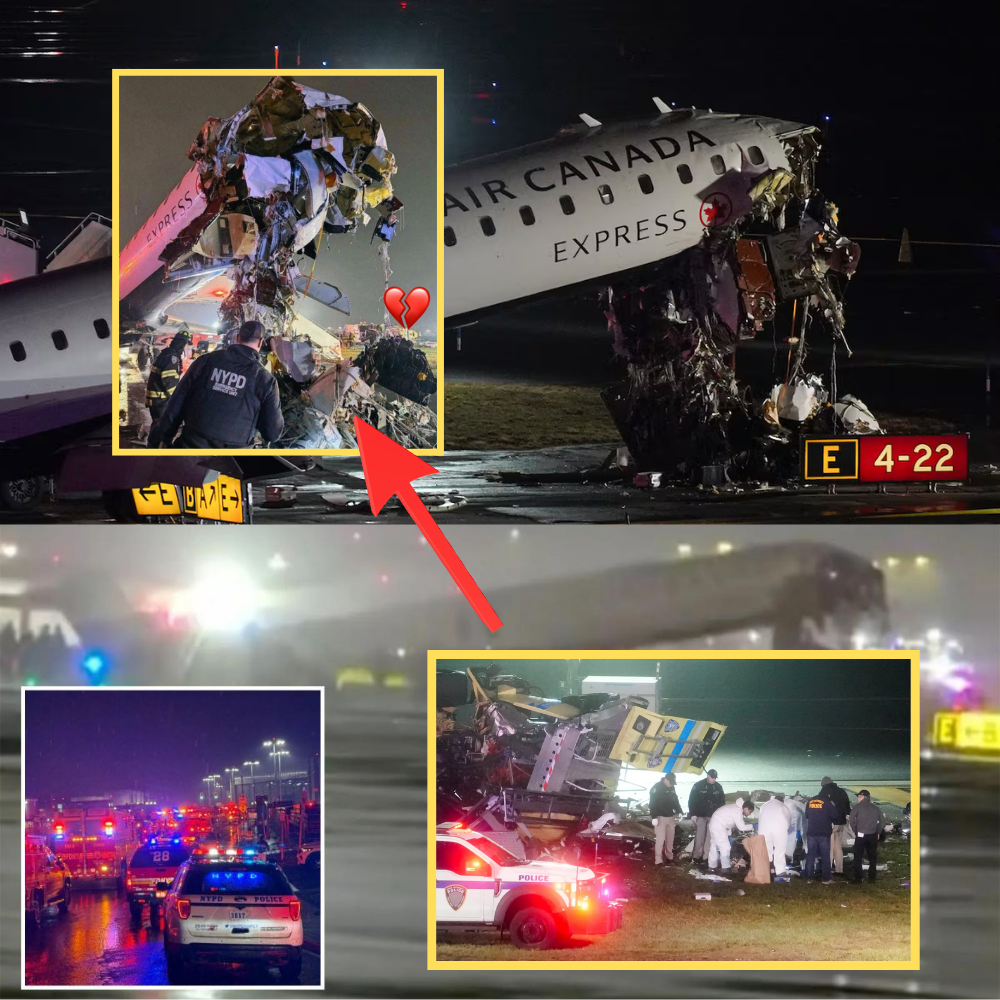
The catastrophic collision at LaGuardia Airport not only shocked the aviation industry but also raised a host of unanswered questions, especially after a cockpit voice recorder was allegedly leaked. While official investigations are still ongoing, initial reports from international sources suggest this was not simply a casualty, but may have been the result of a series of cumulative errors in those fateful seconds.
According to preliminary reports, the Air Canada plane collided head-on with a fire truck operating on the runway during landing. The incident resulted in the deaths of two pilots and injuries to dozens of passengers and ground staff, many of whom required hospitalization in serious condition. The airport was immediately closed, flights were delayed or diverted, causing chaos for hours.
However, what particularly caught public attention was the audio recording allegedly extracted from the cockpit voice recorder – a document usually only released after an investigation is complete. According to sources, this recording captures the final seconds before the collision, in which the pilot utters a phrase described as “unexpected,” suggesting the flight crew may not have been aware of the imminent danger.

Aviation experts analyzing this information believe that if the recording is authentic, it could indicate a serious flaw in the coordination process between air traffic control and ground vehicles. Under standard conditions, all vehicles operating on the runway must be closely monitored to avoid collisions with aircraft taking off or landing. The appearance of a fire truck on the runway at the exact moment the aircraft approached suggests a possible error in coordination or communication.
Another hypothesis being considered is the factor of visibility and environmental conditions. Some reports suggest that at the time of the accident, the airport area may have been affected by low light or unfavorable weather conditions, making observation difficult. If this is true, it is possible that the pilot did not notice the obstacle on the runway until the final seconds, although it still raises questions about the automatic warning systems designed to prevent such situations.
Furthermore, investigators are also examining data from the aircraft’s “black box,” including flight data and cockpit voice recorder. This is considered key to reconstructing the entire sequence of events in the final minutes before the accident. Information such as speed, altitude, landing angle, as well as communications between the pilot and air traffic control, will help determine whether it was human error, technical failure, or a combination of factors.
Meanwhile, eyewitnesses at the scene described the moment of impact as “horrific.” Some surviving passengers recounted feeling only a violent jolt before the plane came to a sudden stop, followed by smoke and the smell of fuel filling the cabin. Rescue teams arrived quickly, but the scale of the incident made rescue efforts extremely difficult.
The families of the victims, especially the two pilots who died, are facing unspeakable grief. Many have called for a transparent and comprehensive investigation to ensure that all causes of the tragedy are clarified, and if wrongdoing is found, those responsible are held accountable.
Authorities such as the Federal Aviation Administration and the National Transportation Safety Board have become involved, coordinating with relevant parties to gather evidence and analyze data. They emphasized that all unconfirmed information, including the circulating audio recording, should be considered cautiously to avoid misunderstandings or interference with the investigation.
However, the existence of the recording – if authenticated – could be a turning point in understanding the nature of the accident. It not only provides a direct cockpit view but may also reveal elements not clearly shown by technical data, such as the pilot’s mental state or split-second decisions.
The LaGuardia Airport incident once again raises concerns about aviation safety, particularly in situations involving simultaneous aircraft and ground operations. It also highlights the urgent need to review current procedures, from personnel training to technology application, to minimize future risks.
As the investigation continues, the global public awaits answers to the most crucial question: what really happened in the final seconds before the collision? And could this tragedy have been prevented if just one small detail had been handled differently? Until those questions are answered, the incident will remain a heartbreaking reminder of fragility of safety in modern aviation.
Để lại một bình luận