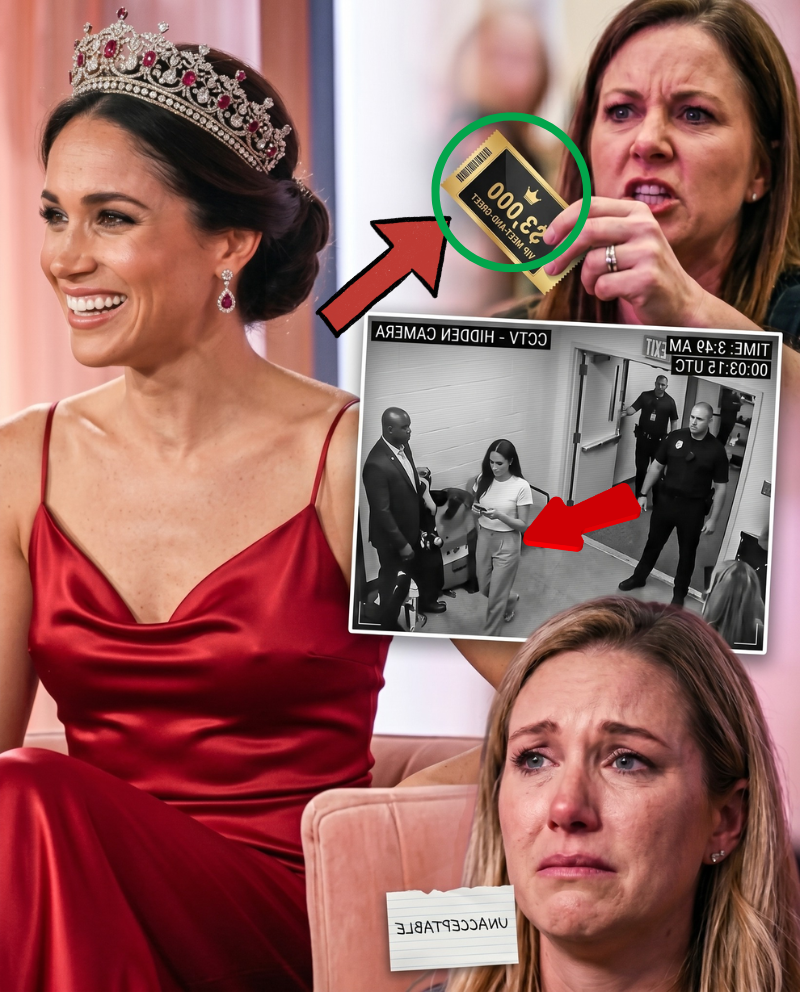
Stories surrounding paid meet-and-greet events are always a sensitive test of the relationship between celebrities and the public. When news broke that Meghan Markle left a high-priced meet-and-greet before it was even finished, the backlash on social media was almost predictable. However, the real issue lies not only in the event itself, but in how it was interpreted, amplified, and transformed into a narrative clashing between “expectations” and “reality.”
In the modern context, fan meet-and-greet events are no longer simply networking activities, but have become part of the experience economy. When ticket prices are pushed up – in some cases reaching thousands of dollars – participants are not only buying access, but also an expectation: of time, attention, and a form of personal “validation” from the person they admire. When any of these elements are not met, feelings of disappointment can quickly turn into outrage.
In Meghan Markle’s case, the information about her leaving the event early was framed within a highly emotional interpretation: “walking away,” “avoiding,” “offensive.” These words not only describe the action but also assign it a moral connotation. However, from an analytical perspective, the difference between factual information and how it is recounted needs to be considered. Public events are often influenced by many factors – from scheduling and security to logistical issues – and are not always fully communicated to attendees.
The “hidden camera” element mentioned in the viral posts further complicates the narrative. In an age where any device can become a recording tool, the lines between public and private space are blurred. Short, context-lacking videos are easily edited and interpreted in multiple ways. This raises questions about credibility: does what is seen reflect the entire event, or is it merely a selective element used to bolster a particular narrative?

Public reaction in such cases is often inconsistent. Some fans feel “betrayed,” especially after significant financial and emotional investment. Others, however, call for caution, emphasizing that conclusions should not be drawn without complete information. This polarization reflects a broader reality: the relationship between celebrities and the public is no longer one-way, but a continuous space of debate where every event can be viewed from multiple perspectives.
From a media standpoint, how the story is told plays a crucial role. The use of strong phrases like “fleeing” or “outrage” is not only intended to attract attention, but also to shape how readers perceive an event before they access the details. This is a common strategy in a content-competitive environment, but it is also a source of much misunderstanding. When emotions are triggered beforehand, the ability to process information in a balanced way is often diminished.
For Meghan Markle, this is not the first time her public image has become the focus of debate. Since stepping down from her official role in the British Royal Family, every action she takes has been under close scrutiny by the media and the public. This creates an environment where every small event can be amplified into a big story, especially when it involves sensitive topics such as responsibility, privilege, and expectations.
Another factor to consider is the shift in how the public perceives celebrities. In the past, the distance between the two sides created a kind of protective “aura.” Today, with social media and live platforms, that distance has narrowed considerably. Fans not only want to see, but also want to “experience” and “interact.” When these expectations are not met, negative reactions can become more intense than before.
However, evaluating such an event requires a balance between the interests of attendees and the operational realities of large-scale events. If there is a discrepancy between what is promoted and what is delivered, it is an issue that needs serious consideration. But at the same time, relying on unverified video clips or one-sided accounts to draw conclusions also carries risks.
On a broader level, this story reflects how information is consumed in the digital age. The rapid spread of information means that narratives are formed almost instantaneously, often before full details are released. In that environment, the ability to distinguish between facts and interpretation becomes more important than ever. Not everything that is widely shared is accurate, and not every strong reaction is based on complete information.
Ultimately, what prolongs such controversies is not just the event itself, but the questions it raises. To what extent are celebrities accountable for meeting expectations?
What role do these public figures play? What demands do fans have when attending paid events? And what role should the media play in balancing attention-grabbing and accurate information?
These questions don’t have simple answers. But the very fact that they continue to be asked shows that the relationship between the public and figures like Meghan Markle is in motion – where each event is not just a moment, but part of a larger dialogue about expectations, responsibilities, and how we understand public image in today’s age.
Để lại một bình luận