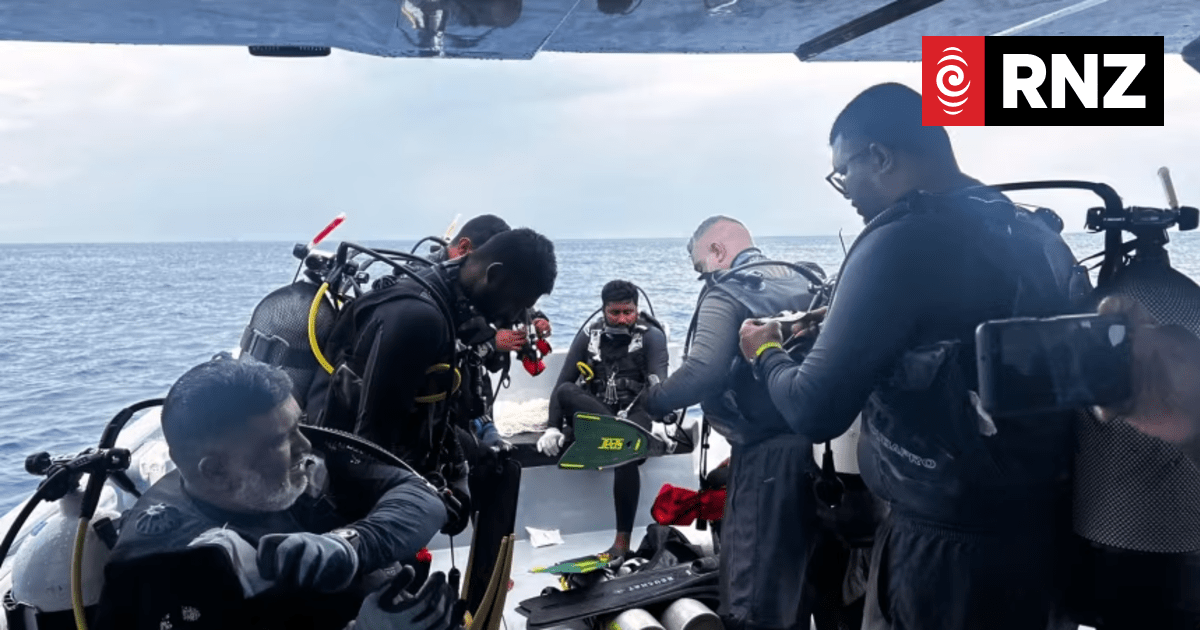
n incorrect mix of gases in the divers’ tanks or human error may have been behind the tragedy in which five Italians lost their lives scuba diving in an underwater cave in the Maldives Thursday, an expert told ANSA Friday.
One of the unanswered questions concerns the gas mix in the tanks used by the divers.
Under certain conditions, even natural gases like oxygen can become toxic, observes Gerardo Bosco, full professor of Sports Physiology at the University of Chieti and director of the Master’s Program in Underwater and Hyperbaric Medicine.
It is therefore very important to recover the tanks for analysis, just as both the wrist computers and the anatomical pathological analyses will reveal much more.
As for the tanks, the mix is prepared on board the vessel and agreed upon with the divers, especially when diving to 50 meters, which, the expert notes, “exceeds the limits of recreational diving and falls within a technical scope.” Typically, the tanks are calibrated with a mix of physiological gases, such as oxygen and nitrogen.
For deeper dives, a percentage of oxygen and nitrogen is replaced with an inert gas like helium, but there is no evidence to indicate whether the tanks of the five Italians were filled this way.
In general, Bosco continues, the mixes used in the tanks “are complex because, when preparing them, it is necessary to consider that, during a dive, every time you descend ten meters, the pressure of each gas increases by one atmosphere.
That is, the individual partial pressures increase.” If mistakes are made in the mix, different problems can arise with different gases.
For example, he continues, “oxygen toxicity can cause both pulmonary and neurological manifestations, such as paresthesia, epilepsy, dizziness, nausea, vomiting.” High nitrogen pressure can cause a sort of narcosis, “an effect similar to alcohol intoxication, with alterations in intellectual abilities and neuromuscular control.
“There is also the risk of carbon dioxide poisoning, following abnormal physical exertion.” Furthermore, it cannot be ruled out that, in addition to these physiological gases, non-physiological gases, such as carbon monoxide, may have come into play.
“This can happen,” he observes, “if the gas supply is contaminated, for example if the air intake for filling the cylinders is too close to the engine exhaust or due to a compressor malfunction,” for example if the lubricating oil overheats and partially burns.
Symptoms in this case include nausea, weakness, mental changes, even convulsions and a syncope episode,” which is a loss of consciousness caused by a transient reduction in blood flow to the brain.
For this reason, says Bosco, “it is absolutely essential to recover the cylinders to reconstruct the accident dynamics.” It’s also important, he continued, to retrieve the computers that divers wear on their arms, which are slightly larger than a normal watch: during the dive, the computer acts as a guide and provides real-time information.
Để lại một bình luận