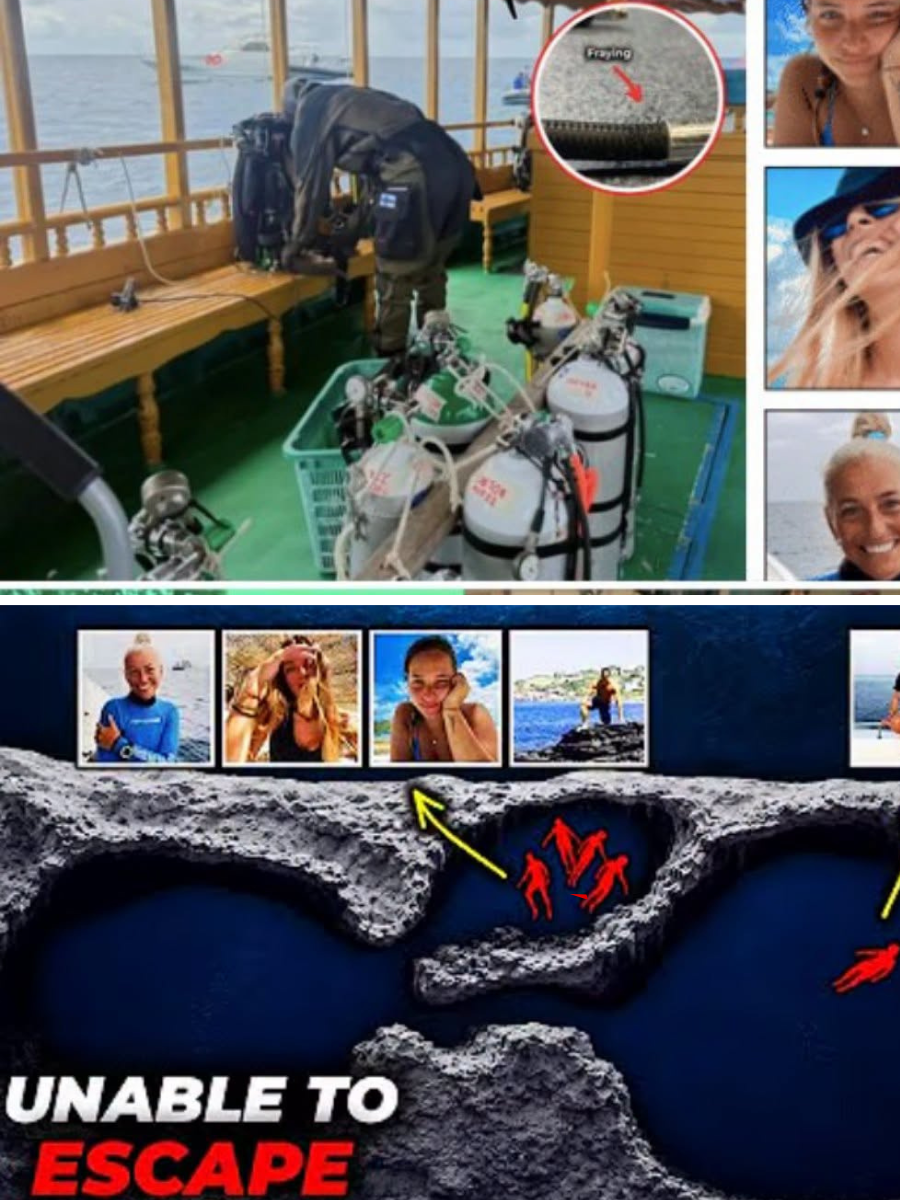
After weeks of rumors, conspiracy theories, and emotional speculation surrounding the deaths of five experienced Italian divers off the coast of the Maldives, authorities have now released what they call the definitive reconstruction of the tragedy — and the truth is more horrifying precisely because it was so simple.
There was no equipment sabotage. No violent ocean predator. No hidden criminal involvement.
Instead, investigators say the deaths were caused by a single navigational mistake made deep inside an underwater cave system where one wrong turn became a fatal sentence.
The final forensic and dive-analysis report, released Thursday morning after an intensive multinational investigation, paints a devastating picture of confusion, darkness, and mounting panic during what experts describe as a “catastrophic spatial disorientation event.”
The five divers, all certified professionals with years of deep-water experience, entered the submerged cave shortly after sunrise during what was supposed to be an advanced recreational exploration dive near a remote reef formation south of Malé.
Conditions above the surface were considered ideal. Visibility was excellent. Currents were mild. Nothing initially suggested danger.
But investigators now believe the group unknowingly entered a secondary tunnel network located approximately 38 meters below sea level — a section local guides rarely approach because of its unusually complex layout and high concentration of suspended sediment.
According to the reconstructed dive timeline, the disaster began with a single decision.
At approximately 9:14 a.m., one member of the group reportedly took a narrow left passage that appeared, at first glance, to connect back toward the main exit corridor. Underwater mapping later revealed the tunnel instead descended deeper into a maze-like chamber system with multiple dead ends and almost no natural light.
“The cave geometry created a perfect trap,” one forensic dive analyst stated during the press briefing. “Once visibility deteriorated, every direction would have appeared identical.”
The report explains that the divers likely realized the error within minutes. By then, however, the situation had already begun spiraling out of control.
As the group attempted to reverse course, one diver accidentally disturbed fine limestone sediment coating the cave floor and walls. Experts say this instantly triggered what divers refer to as a “silt-out” — a condition where visibility collapses to near zero within seconds.
Inside the cave, darkness became absolute.
Investigators recreated the scene using identical equipment and lighting systems. Their findings were chilling: after sediment dispersion, visibility inside some sections dropped to less than 20 centimeters.
“At that point, they were effectively blind,” the report concluded.
What followed was a desperate 36-minute fight for survival.
Using tank pressure data, recovered dive computers, and cave mapping simulations, investigators managed to reconstruct the group’s final movements almost minute by minute.
The divers initially remained together, attempting to locate the original guide line leading back to open water. But in complete darkness, even maintaining physical contact became increasingly difficult.
Audio simulations released alongside the report suggest the cave’s structure amplified breathing sounds while disorienting directional awareness. Investigators believe this psychological effect dramatically accelerated panic levels as oxygen reserves rapidly diminished.
One diver appears to have attempted an emergency ascent through a vertical shaft that ultimately led nowhere.
Another became trapped briefly between narrowing rock formations while trying to navigate a collapsed corridor.
The report states that increased breathing rates caused by stress and exertion likely doubled normal air consumption.
Within less than half an hour, their margin for survival had virtually disappeared.
Perhaps the most heartbreaking discovery came from the final positioning of the bodies.
Rescue divers found three of the victims only meters away from the correct exit tunnel.
“They were incredibly close,” said one recovery specialist involved in the operation. “Close enough that, under clear conditions, they probably would have survived.”
But clear conditions no longer existed.
The investigation determined that the divers unknowingly circled portions of the cave multiple times as they searched for a way out. Without visibility, natural orientation markers vanished completely.
The underwater labyrinth had effectively erased all sense of direction.
Authorities also confirmed that none of the victims violated standard oxygen protocols before entering the dive. Equipment recovered from the scene was found to be functioning normally, further reinforcing the conclusion that environmental disorientation — not mechanical failure — caused the catastrophe.
“This was not recklessness,” the report emphasized. “This was a sequence of escalating environmental conditions inside an inherently unforgiving environment.”
The tragedy has reignited global debate within the professional diving community over the growing popularity of deep cave tourism in exotic destinations.
Several veteran cave divers have since warned that even highly trained professionals can become vulnerable when operating in unfamiliar underwater systems.
“Caves do not forgive mistakes,” one international instructor said after reviewing the findings. “The ocean gives you room to recover. Caves often do not.”
The Maldives government announced that new restrictions are now being considered for advanced cave diving excursions, including mandatory local guides, enhanced mapping requirements, and stricter weather-current assessments before descent authorization.
Meanwhile, the families of the victims released a brief joint statement thanking rescue teams and investigators for finally providing answers after weeks of agonizing uncertainty.
“Knowing the truth does not ease the pain,” the statement read, “but it allows us to stop imagining even worse possibilities.”
Back at the reef where the tragedy unfolded, local divers say the area has become eerily silent.
Boats now avoid the entrance to the cave system.
Some fishermen reportedly refuse to pass over the site after dark.
What remains is the haunting reality that five experienced divers did not lose their lives to a monster, a storm, or sabotage — but to one split-second navigational decision made in total darkness beneath the sea.
A single wrong turn.
And 36 terrifying minutes inside a labyrinth with no escape.
Để lại một bình luận