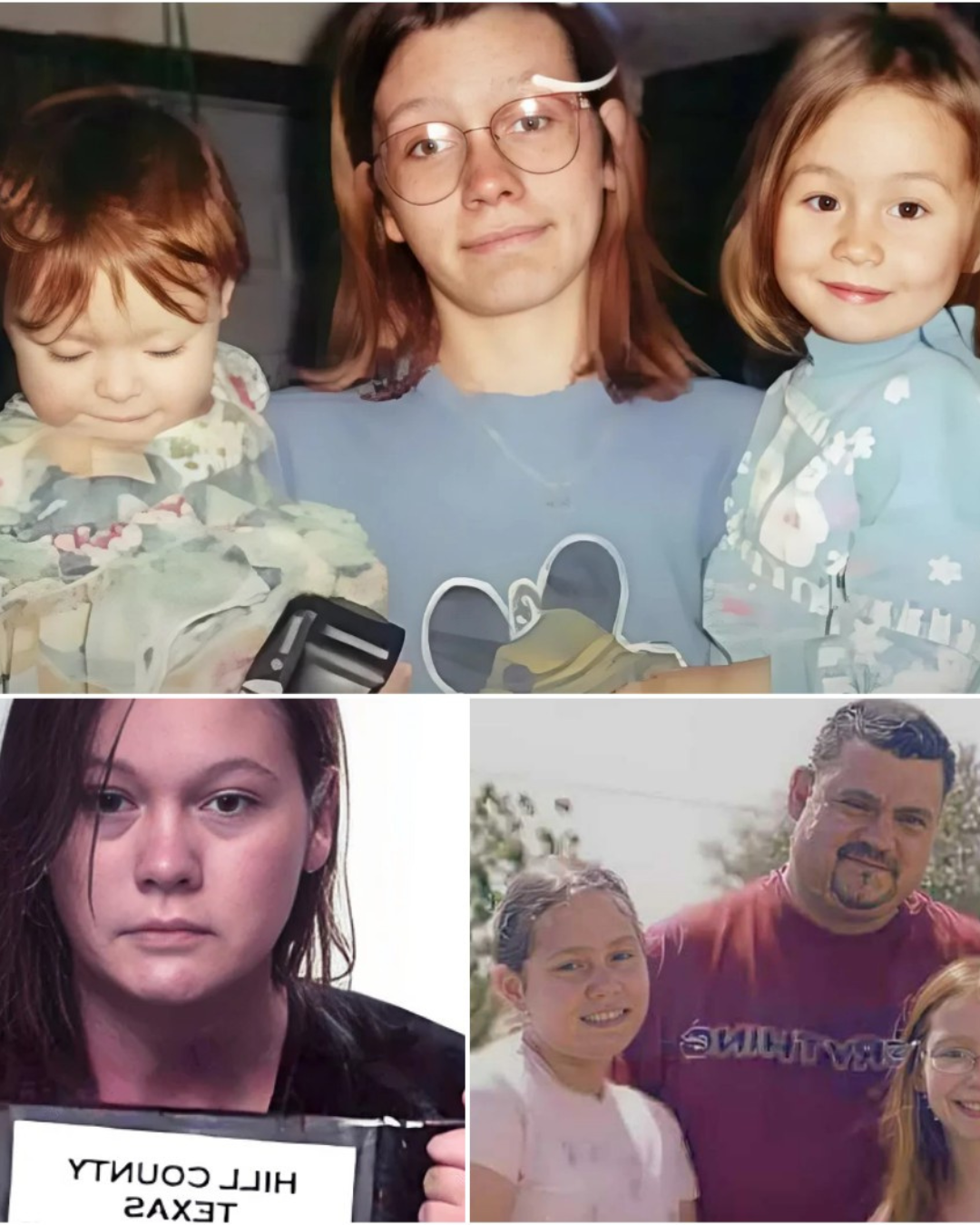
“I have a surprise for you,” the mother said as the two girls got into the car. It was Friday evening, the time when, according to the court schedule, the children were allowed to be with their mother after weeks of separation. Thirteen-year-old Kiersten and twelve-year-old Kelsey had just kissed their father goodbye. None of them knew it would be their last.
Two weeks apart had made the children excited. They asked where they were going. The mother smiled and answered briefly, “It’s a secret.” The car left town, heading south. The sunset was fading. As the car turned off the main road onto a rough red dirt road, Kiersten began to feel uneasy. In the distance was an abandoned farmhouse, its roof askew, its windows dark. She asked her mother why they were stopping there. There was no clear answer.
At 9:13 p.m., 911 received a call from a woman. Her voice was even, slow, and steady. “I just did something,” she said. The coordinator asked what had happened. There was a brief silence, enough to hear breathing. “One of them was crying for help,” the woman continued. “The other… there was nothing more that could be done.” In the background, a faint child’s voice could be heard.
When police arrived at the farm, the scene left even the most seasoned investigators speechless. One of the two girls had been rushed to the hospital, in critical condition from severe blood loss. Doctors said that if they had been a few minutes later, she wouldn’t have survived. The other had died at the scene. It wasn’t an accident. It was a deliberate act.
Just 24 hours earlier, the father had stood before the judge in family court. He brought documents, text messages, diaries – things that showed his relationship with his ex-wife was at an alarming level. He expressed concerns about his children’s safety. Records showed that he had initially requested continued supervision during visitation. But then, at the last minute, he changed his mind. No child protection officer attended the trial that day. There was no updated psychological assessment. The decision to grant unsupervised visitation rights was signed under “proper procedure” but **lacking in actual supervision**.

Following the tragedy, a barrage of questions arose. Why was there no follow-up? Why no check-up call? Why weren’t prior warnings connected to form a better risk picture? Subsequent internal reports acknowledged “systemic gaps”—where responsibility was so fragmented that no one was ultimately accountable.
In criminal court, the mother did not deny her actions. She presented a cold but consistent logic: she believed she was “protecting” her children from a future she perceived as worse than death. Psychologists call this **a distorted salvation mindset**—where the perpetrator redefines violence as love, transforming power into sacrifice. The court did not accept this argument. A life sentence was handed down.
Seven years later, in a supervised visiting room, the surviving daughter agreed to see her mother one last time. They sat opposite each other across a metal table. The mother wept, apologized, recounted her “reasons,” spoke of fear, despair, and the distorted belief that she had no other choice. According to the record, it was the first time she had apologized directly.
The meeting ended in silence. As she stood to leave, the daughter turned back and said **four words**. Witnesses said it was neither an accusation nor complete forgiveness. Public documents note that those four words **conveyed the only truth a surviving child could say in that moment**: *a boundary*. The father, standing in the hallway, collapsed upon hearing those words again, for he understood: his daughter had just saved herself, in a way the system had failed to do.
Why did the mother believe killing her child was an act of love? Experts point to three common factors in similar cases: prolonged isolation, a feeling of losing control after a custody dispute, and an unwavering belief in a self-created narrative. When these factors encounter a lax oversight system, the consequences can be irreversible.
This story is not just a family tragedy. It is an indictment of how we handle the risks in child custody disputes, where “proper procedure” is confused with “sufficient safety.” Because sometimes, a last-minute change of mind – unchecked, unmonitored – can open the door to the worst.
Để lại một bình luận