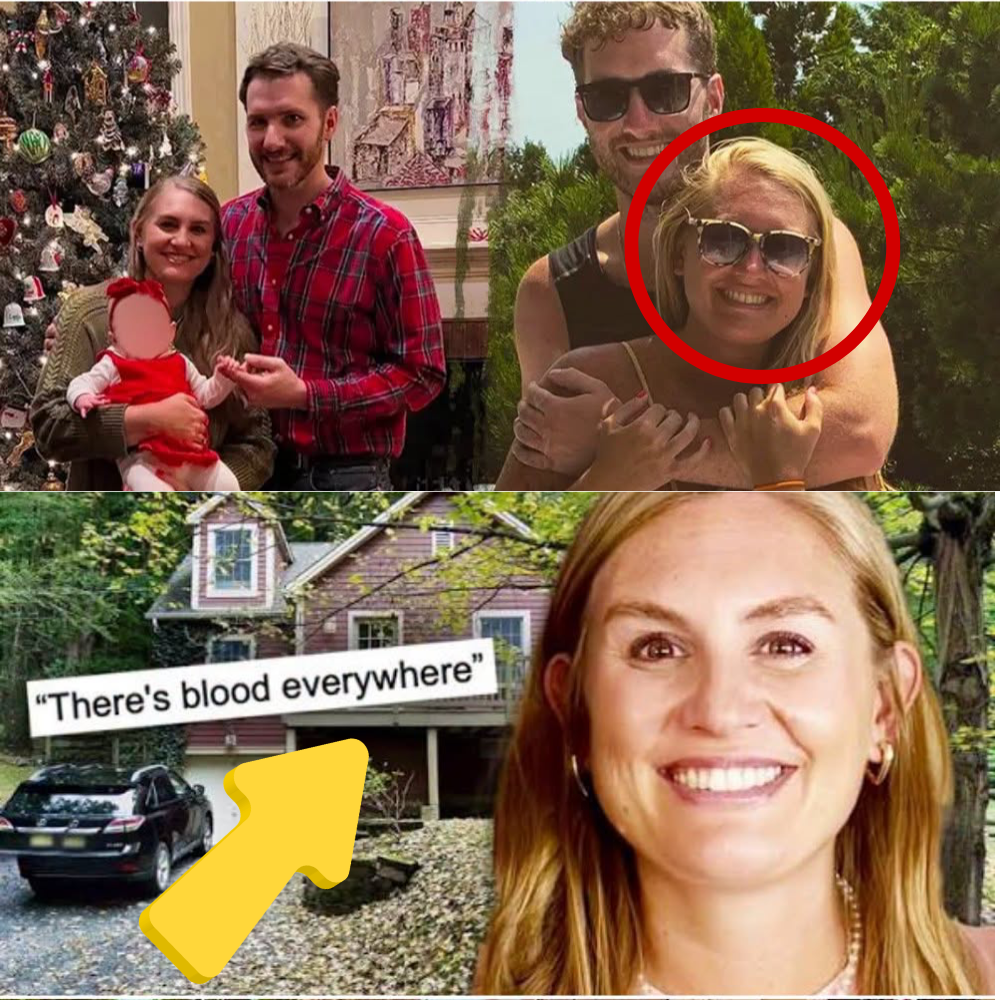
On the afternoon of June 6, 2026, an emergency call from a home on Pottersville Road in Chester Township, New Jersey, marked the beginning of a case that remains unsolved more than two months later. The caller was James “Conor” Hanlon, the husband of Brooke Hanlon—a 35-year-old psychotherapist and new mother. When emergency responders arrived, Brooke was found in the home’s second-floor bedroom; she was unresponsive and not breathing. What initially appeared to be a medical emergency quickly escalated into a homicide investigation.
The Morris County Prosecutor’s Office later confirmed that Brooke died from multiple sharp-force injuries and ruled the manner of death a homicide—meaning her death was caused by another person. This is a crucial legal distinction: while authorities determined Brooke was the victim of a homicide, that is entirely different from identifying the perpetrator. To date, investigators have not announced a suspect, made any arrests, or publicly named a person of interest.
What makes this case particularly compelling is not merely the victim’s age, her profession, or the fact that she had recently become a mother. It also hinges on a detail that is deceptively simple yet carries immense weight in any criminal investigation: the 911 call made by her husband.
A 6-minute, 36-second audio recording, released in July, allowed the public to hear the chaotic moments immediately following Conor’s discovery of his unconscious wife. He stated that Brooke was not breathing, requested CPR instructions, and at one point mentioned there was blood everywhere. The dispatcher guided him through resuscitation efforts while emergency responders were dispatched to the home.
A 911 call made under such circumstances almost immediately becomes a focal point of attention. Listeners might detect panic, pauses, voice fluctuations, or seemingly disjointed speech. But the question remains: can an ordinary person speak with perfect coherence immediately after discovering their spouse critically injured and facing imminent death?
This is precisely where the official investigation and the “internet investigation” begin to diverge.
Investigators have access to the crime scene, physical evidence, phone records, medical files, forensic results, travel times, surveillance footage, digital data, and witness statements. The public, however, sees only a fraction of the full picture. Consequently, attempting to determine guilt based solely on a caller’s voice during an emergency call can lead to dangerous conclusions.
Nevertheless, the 911 call remains an undeniably crucial piece of the puzzle. It helps establish the time help was requested, what the caller observed at that moment, and the initial actions taken upon finding the victim. More importantly, the call can be cross-referenced with other independent evidence to reconstruct the sequence of events.
According to released information, it was Conor who discovered Brooke and called for emergency assistance. Authorities quickly reclassified the case from a medical emergency to a suspicious death investigation. Just thirteen minutes after the call, emergency dispatch records were updated to reflect a “suspicious death,” and a major crimes unit was mobilized. This indicates that personnel at the scene recognized signs inconsistent with a routine medical emergency. Yet, “suspicious” does not equate to “perpetrator identified.”
In the days that followed, the house on Pottersville Road became the hub of a massive investigation. Released dispatch logs reveal that investigative, forensic, and evidence-processing teams worked at the property for days, continuing until the scene was cleared on June 12.
This prolonged activity is significant. While a case with a straightforward solution might allow for a quick processing of the scene, a case where the perpetrator remains unknown turns every square centimeter of the location into a potential source of value. A fingerprint, a fabric fiber, a footprint, a biological sample, an electronic device, or the specific placement of an object could prove to be crucial evidence weeks later.
For this very reason, the silence maintained by investigative agencies should be viewed with a measured perspective.
While the community is eager to know who killed Brooke, investigators have valid reasons for withholding certain information. In a criminal case, keeping specific details under wraps allows police to verify the statements of future suspects. If an individual accurately reveals a detail that has never been made public, it can serve as a significant lead.
A veteran investigator interviewed by Fox News also suggested that the authorities’ decision to withhold certain information might be a strategic move to safeguard the integrity of the investigation. He emphasized…
…that in complex cases, investigators need to start at the crime scene and let the evidence guide them, rather than trying to force events to fit a preconceived theory.
This principle was particularly crucial in the Brooke Hanlon case, given the rapid surge in public interest.
Brooke was not an unknown figure; she was a licensed psychotherapist who worked with children, adolescents, and families in need of support. Those who knew her described her as a compassionate person who made a positive impact on those around her. A close college friend shared photos of Brooke from her time living and studying in Boston, offering the public a glimpse of a person far different from the “murder victim” portrayed in news reports.
Beyond the details in the case file lay a woman with plans for the future—a family, a career, and a child too young to grasp that their life had just changed forever.
Brooke and Conor had lived in Boston before moving to New Jersey. They married in 2021 and subsequently bought a home in Chester. In 2025, they welcomed their first child, Avery. According to recent reports, the child was inside the home at the time of the incident but was unharmed.
That detail makes the case all the more heartbreaking. A child, barely a year old, lost their mother in the very place that should have been the safest sanctuary. Yet, the fact that the child was uninjured also compels investigators to scrutinize exactly what transpired inside the home that afternoon.
These are among the questions the public is eager to have answered, though authorities have not yet released full details.
Who was inside the house?
Who left the house?
When was Brooke last seen?
Where was Conor before he called 911? Was anyone else present in the area at the time?
Were there signs of forced entry?
Has the weapon been found?
These questions remain, but it is crucial to distinguish between investigative inquiries and actual conclusions.
One of the greatest risks with cases that garner significant social media attention is how quickly questions morph into accusations. When the public learned that the husband was the one who called 911, some immediately cast suspicion on him. When it became known that he left New Jersey for Massachusetts after the incident, others viewed that move as a suspicious act.
Yet, such actions do not, in themselves, prove criminal wrongdoing.
By August, Conor had retained a lawyer and continued to communicate with investigators through legal counsel. Authorities have not publicly named him a suspect or a person of interest in the crime.
After nearly three months, Conor spoke publicly for the first time. In comments reported by the media, he expressed that he was absolutely heartbroken and denied any involvement in his wife’s death. Those statements cannot prove his innocence on their own, nor can they be taken as evidence of guilt. Only evidence gathered during the investigation can determine that.
This is precisely the boundary that the media must strictly respect.
A case without a named suspect is not an invitation for the public to single out an individual to accuse.
An emotional 911 call is not a lie detector test.
Hiring a lawyer is not evidence of a crime.
And police silence does not mean they are doing nothing.
In reality, a prolonged silence may reflect an investigation that is seeking evidence strong enough to bring formal charges. In the U.S. justice system, the threshold for arresting and prosecuting an individual is far higher than the standard required for the online community to form suspicions.
That is also why the absence of an arrest warrant weeks into a case does not necessarily imply a police failure. A homicide investigation can take months to resolve if forensic evidence requires time for analysis or if investigators are working to verify various potential scenarios.
In a case involving a death in a private home, the timeline is particularly crucial—often more so than any rumors circulating.
The interval between the last time Brooke was seen alive and the moment Conor called 911 can help investigators narrow their focus. Data from phones, traffic cameras, neighbors’ surveillance systems, online activity, financial transactions, and electronic device location logs can all help reconstruct the timeline.
If a statement conflicts with objective data, it becomes a significant red flag. Conversely, if a statement aligns with independent evidence, it might serve to rule out a particular theory.
This is why professional investigators do not rely on the Internet to determine who appears most suspicious; they require evidence that will hold up in court.
Meanwhile, the community of Chester is left to grapple with a chilling question: where is the person who killed Brooke Hanlon?
Neighbors interviewed by the press say they have become more vigilant since the incident. Some report paying closer attention to unusual sounds and worry that…
The perpetrator has not yet been identified.
However, it must be acknowledged that authorities have not released evidence indicating that an unidentified killer poses an ongoing threat to the community. While the residents’ sense of unease is psychologically understandable, it should not lead to the conclusion that the area faces a specific danger that the police have not confirmed.
Only a few facts are certain at this point: Brooke Hanlon died in her home on June 6, 2026; her death was ruled a homicide caused by multiple sharp-force injuries; Conor Hanlon called 911 after discovering her; investigators processed the scene over several days; no suspect or person of interest has been publicly identified by authorities; and the investigation is ongoing.
Everything else remains a question.
And perhaps the biggest question is not “Who looks the most suspicious?” but rather “What evidence can prove what actually happened?”
That is a question only the investigation can answer.
Brooke dedicated her career to helping others navigate psychological struggles and difficult times in their lives. Yet, her own life ended in circumstances that remain unsolved.
Her daughter will grow up with questions about a mother of whom she has few memories. Brooke’s family will continue to wait for answers. Meanwhile, investigators must carry on with the most difficult task of all: distinguishing fact from speculation, evidence from rumor, and what can be proven in a court of law from what merely seems plausible to the public.
The 911 call may help reconstruct the opening moments of the tragedy. It might contain crucial details that investigators are cross-referencing with other evidence. But it cannot tell the whole story on its own. And when a murder case remains without a suspect, a prolonged silence does not necessarily signal the end of the story. Sometimes, it is precisely the time when investigators are piecing together the final fragments of evidence before making a move that could completely alter the course of the case.
Until that happens, Brooke Hanlon remains more than just an unsolved homicide file. She was a mother, a wife, a psychologist, and a daughter in a family grappling with an irreversible loss.
And beneath all the questions surrounding the 911 call, her husband, the house, and Brooke’s final moments, there remains the simplest yet most painful question of all:
Who took her life—and when will Brooke’s family finally get answers?
Để lại một bình luận