
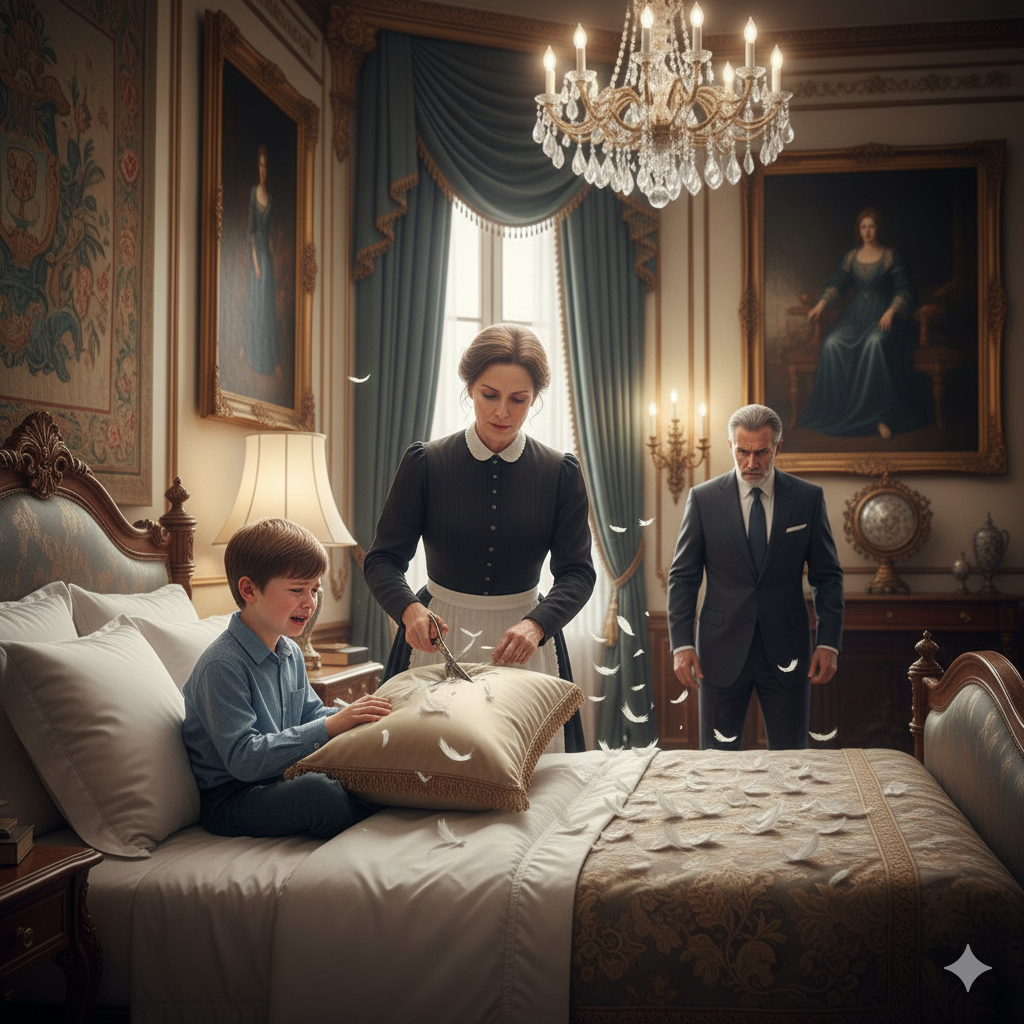
“I Can’t… I Can’t Sleep!”
Leo’s scream ripped through the night, raw and desperate.
It was almost two in the morning in the sprawling colonial mansion on the edge of the city. The echo of his cries bounced off the marble floors and high ceilings, chilling the blood of the few staff members still awake.
Leo was only six, but his eyes carried a weight that no child should ever bear. That night—like countless nights before—he struggled against his father’s grip.
James Hawthorne, a millionaire businessman with sharp suits and sharper eyes, held his son by the shoulders, face tight with exhaustion and frustration.
“That’s enough, Leo,” he growled, voice low and harsh. “Sleep in your bed like a normal boy. I need to rest too.”
He pressed the boy’s head down onto the silk pillow at the head of the bed. To James, it was just a luxury pillow, another symbol of the life he had fought to build.
To Leo… it was a trap.
The instant his head touched the pillow, his body arched violently. A scream tore from his throat—not a tantrum, not rebellion, but pure, unfiltered pain. He clawed at the air, tears streaming down his flushed face.
“No, Dad! Please! It hurts! It hurts!”
James, blinded by fatigue and pride, shook his head. “Stop exaggerating. Always the same drama.”
He locked the door and left, confident he had enforced discipline, oblivious to the quiet witness hidden in the shadows.
Clara Rivera, the new nanny, had seen enough. Gray hair pulled into a neat bun, hands roughened by years of work, and eyes that noticed what others overlooked—she knew this wasn’t a spoiled child. This was terror.
Since arriving at the mansion three weeks ago, Clara had noticed things no one else did. During the day, Leo was cheerful, drawing dinosaurs and sneaking around corners to scare her with timid laughter. But at night… fear gripped him. He clung to doorframes, begged not to go to his room, and tried to sleep anywhere but his bed—on the sofa, the hallway rug, even the hard kitchen chair.
Mornings revealed the evidence: flushed cheeks, irritated ears, faint bruises around his temples. Victoria, James’s fiancée, always explained it away.
“Probably an allergy. Or he scratches himself in his sleep.”
Victoria’s smile was flawless—blonde hair, designer dresses, the perfect trophy fiancée—but Clara saw the impatience, the irritation when Leo sought comfort, the subtle coldness in James’s hugs. To them, Leo wasn’t a child. He was a nuisance.
That night, as muffled sobs drifted through the mansion, Clara’s resolve snapped. She waited until the house fell into silence, until footsteps faded and the creaks of the old mansion whispered in the dark.
With a small flashlight from her apron and the master key she’d quietly copied on her second day, she crept to Leo’s door.
What she discovered made her heart seize.
The pillow… it wasn’t ordinary. A tiny, almost invisible device was embedded inside, wires coiled beneath the silk. A small battery pack and a pressure sensor—when weight was applied, it delivered a mild but targeted electric shock straight to the temples. Enough to cause pain and panic, not enough to leave permanent marks.
Leo’s screams weren’t imaginary. They were real. The pillow had been rigged to send jolts of pain whenever he touched it.
Clara held back tears, her hand trembling. The boy, the innocent six-year-old, had been trapped night after night, and no one—no one—had noticed.
She picked him up gently, carrying him away from the bed, feeling the weight of his fear settle on her shoulders.
“What… what is this?” she whispered to herself.
And that was only the beginning. Because what Clara was about to uncover next would shock the entire household—and reveal a darkness far deeper than any silk pillow could hide.
Clara didn’t sleep that night.
She carried Leo to her small room in the staff quarters, laid him on her narrow bed, and watched him finally drift off—peaceful, tear-streaked face relaxed for the first time in months. She photographed the pillow from every angle, then carefully removed the device and hid it in a locked tin box under her bed.
By morning, she had a plan.
She acted normal—served breakfast, helped Leo dress, smiled at Victoria’s complaints about the coffee being too strong. But inside, she was piecing together the fragments.
Why would anyone torture a child like this? Not kill—torture. Slowly. Night after night.
The answer came two days later, when she overheard Victoria on the phone in the study.
“No, the little brat still cries every night,” Victoria hissed, voice low but venomous. “But the pillow’s working. He’s exhausted. Weak. The doctors say the stress is affecting his health. Keep pushing the custody papers—James will sign anything if it means peace.”
Clara froze behind the door.
Custody?
James’s ex-wife, Elena, had died in a car accident two years ago. Everyone knew that. James had full custody. There was no one to fight for Leo.
Unless…
Clara’s blood ran cold.
She began searching quietly—drawers Victoria left unlocked, files in the study when the couple was out. It didn’t take long.
Hidden in a false-bottomed drawer: medical reports claiming Leo suffered from “severe psychological instability,” “violent outbursts,” and “potential danger to himself and others.” All signed by a psychiatrist Clara had never seen visit the house.
Insurance policies—massive ones—naming Victoria as beneficiary in case of Leo’s “incapacitation” or death.
And most damning: an email chain between Victoria and a lawyer.
“If the boy is declared unfit, James gets sympathy, I get control of the trust Elena left. The car accident was clean—no one suspected. This will be too. Once he’s institutionalized, the money’s ours.”
Clara nearly dropped the papers.
Elena’s “accident” hadn’t been an accident. Victoria had been James’s mistress then—arranged the crash to eliminate the wife. Now she was eliminating the son, the only obstacle to full control of the Hawthorne fortune.
The pillow wasn’t just punishment.
It was slow murder—driving Leo toward a breakdown, a “tragic decline” that would end with him institutionalized or worse. All while Victoria played the caring stepmother-to-be.
Clara acted fast.
She contacted Elena’s sister, Aunt Sofia, who lived abroad and had been cut off after the funeral. She sent the photos, the documents, the recording she’d made of Victoria’s phone call.
Then she waited.
Three nights later, James was away on business. Victoria was hosting a small dinner party—lawyers, investors, all people who could help seal Leo’s fate.
Clara served the wine with a steady hand.
At 10 p.m., the front gates burst open.
Police cars. Lights flashing. Aunt Sofia at the front, flanked by detectives.
Victoria’s wine glass slipped from her fingers as officers read her rights: conspiracy to commit murder, child endangerment, fraud.
James arrived home at midnight to a house swarming with investigators. He collapsed when shown the evidence—his fiancée’s emails, the rigged pillow, the forged medical reports.
“I didn’t know,” he kept repeating, voice broken. “I thought he was just… difficult. I trusted her.”
He held Leo that night—really held him—for the first time in years, sobbing apologies into his son’s hair.
Victoria was convicted six months later. Life without parole.
James sold the mansion—too many ghosts—and moved with Leo and Clara to a quiet house by the sea. Clara stayed, not as a nanny, but as family.
Leo slept in his own bed now, with a simple cotton pillow and a nightlight shaped like a dinosaur.
Some nights, he still woke up crying.
But now, there were arms waiting to hold him.
And a father who finally understood that the real monsters weren’t under the bed.
They were the ones who put them there.