
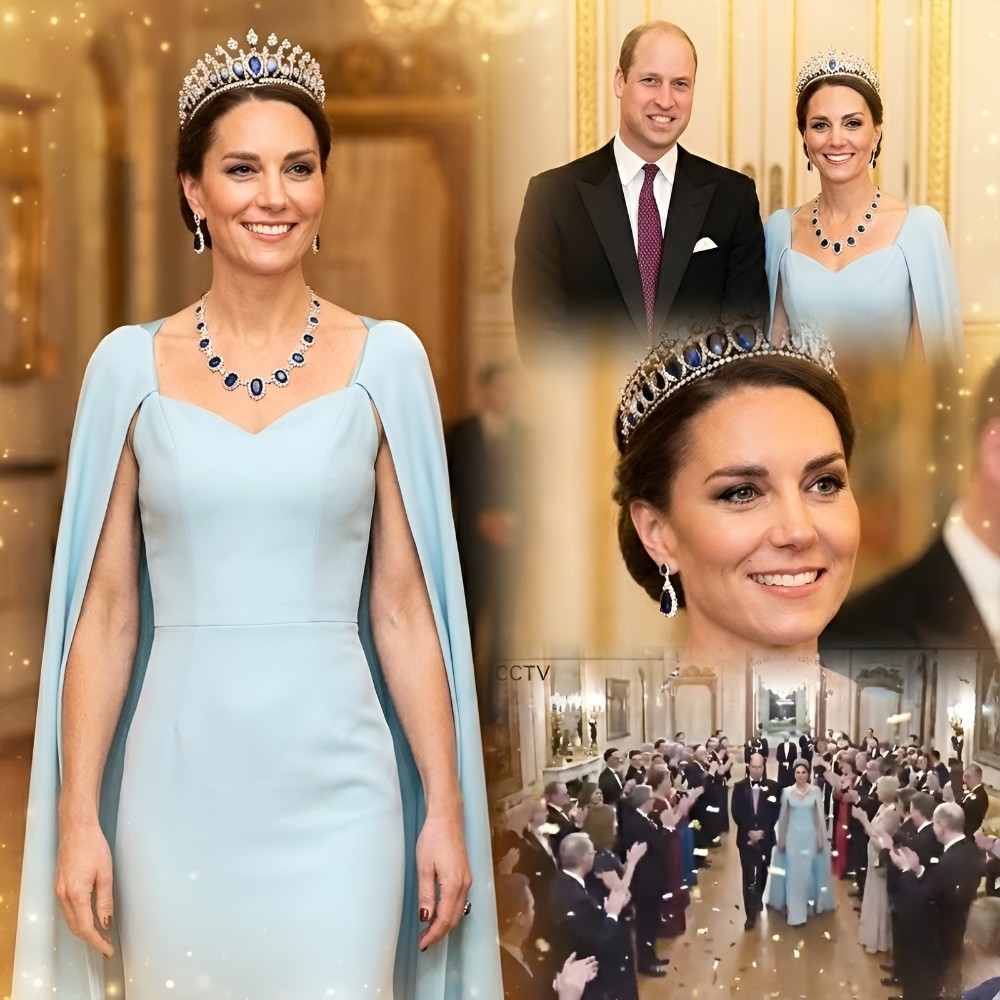
Princess Catherine's appearance at a recent royal event quickly transcended the boundaries of a typical formal ceremony to become a global media phenomenon. In a space filled with lights and ceremony, where every detail was meticulously considered, Catherine of Wales, clad in a historically significant gown and the rare Strathmore Rose tiara, created a moment described as “storming” among royal observers. This wasn't just due to visual beauty, but also to the profound symbolic meaning that her choice suggested.
From the moment Catherine entered the hall, the atmosphere seemed to change. Her gown, designed in a classic style with a silhouette reminiscent of the golden age of the British monarchy, combined with exquisite craftsmanship, created a feeling that was both dignified and graceful. However, it was the Strathmore Rose tiara that truly became the focal point. This piece of jewelry, steeped in nearly a century of history, once belonged to the Royal Family but remained largely “dormant” in archives, never used in modern events and, notably, never worn by Queen Camilla.
Catherine's choice of the Strathmore Rose immediately raised a host of questions. In the context of the British Royal Family's cautious approach to symbolism and hierarchy, no detail is accidental. A tiara is not simply jewelry; it is a symbol of status, role, and succession. Therefore, the fact that a Princess of Wales wore a historical tiara never associated with the reigning Queen opened up vast possibilities for interpretation regarding the message the Royal Family wanted to convey.
From a topical perspective, this moment occurred in a particularly sensitive context. After a long period of Catherine's absence from public view due to health reasons, many speculations arose, ranging from genuine concerns to speculative theories. Her reappearance, with its powerful, refined, and highly symbolic appearance, dispelled much of that doubt. Catherine not only returned, but returned in a way that forced the public to reconsider her position within the current and future structure of the Royal Family.
The Strathmore Rose is not a tiara that frequently appears in Royal photo books. Crafted in the early 20th century, the tiara has a lighter, more elegant style compared to the more powerful tiaras like the Lover's Knot or the Cambridge Lover's Knot that are often mentioned. The delicately arranged rose motifs create a soft, feminine yet sturdy feel. This balance has led many commentators to believe that the Strathmore Rose suits Catherine's image – a woman who harmonizes tradition and modernity.
The fact that this tiara never belonged to Camilla further enhances the symbolic significance of the event. In royal history, the transfer and use of jewelry has always reflected subtle shifts in roles and influence. Camilla, as Queen, was often associated with tiaras that had a clear history, directly inherited from previous generations. In contrast, the Strathmore Rose, with its almost blank “history,” opens the possibility of being redefined – and Catherine was the first to bestow a new narrative upon it.
The public reaction demonstrates the power of this symbol. On social media platforms, images of Catherine wearing the Strathmore Rose were shared at lightning speed. Many saw this as a milestone indicating Catherine's gradual positioning as a central pillar of the future Royal Family. Comments revolved not only around beauty or fashion, but also focused on the question: could this be a visual preparation for her future role as Queen?
From a political perspective, this event reflects how the British Royal Family is adapting to the modern social context. In an era where faith in traditional institutions is no longer taken for granted, the Royal Family is compelled to communicate with the public through subtle symbols rather than direct statements. Catherine's appearance wearing a rare, historic crown is a form of “silent language,” allowing the public to interpret it themselves while remaining within controlled boundaries.
The gender and generational factors in this story cannot be ignored. Catherine represents a new generation of royal women: well-educated, with their own voice, and understanding the power of image. Her wearing a crown never used by Queen Camilla is not confrontational, but rather a parallel between the present and the future. It sends the message that the Royal Family exists not only in the present but is always preparing for continuity.
The choice of historic ceremonial attire further reinforces this message. While many other members of the Royal Family favor modern designs, Catherine chose to return to classic silhouettes, as a reminder of the historical depth she represents. This is particularly significant in this context.
British society is facing numerous challenges regarding national identity and cohesion. The image of a Princess of Wales honoring history in a subtle way can be seen as an affirmation of the continuity of the Royal Family.
Royal observers also point out that this is not the first time Catherine has used clothing and jewelry to send a message. Over the years, she has frequently chosen items with a legacy, from jewelry of the late Queen Elizabeth II to designs reminiscent of Princess Diana. However, the Strathmore Rose marks a new step, as it is not merely a legacy, but a repositioning of an icon that has never had a clear “role” in the modern era.
This event also demonstrates how the Royal Family uses timing to maximize impact. Catherine's reappearance after a long absence was enough to attract attention, but combining it with a powerful symbol like the Strathmore Rose elevated the moment to a historical milestone. This is proof that the Royal Family, despite its traditional appearance, operates with sophisticated media calculations.
In this context, the question of Catherine's future role becomes increasingly clear. There were no official statements, but images sometimes speak louder than words. Catherine's appearance with a rare, historic crown, at a highly symbolic ceremony, can be seen as visual preparation for a more distant future – where she is not just the Princess of Wales, but a central symbol of the British Royal Family.
Ultimately, this momentous event demonstrates the power of seemingly small details in royal life. A crown, a ceremonial dress, a well-timed appearance can trigger a wave of interpretation, debate, and expectation. Catherine of Wales, through her subtle and symbolic choice, transformed a solemn ceremony into a silent declaration of her status, health, and future role in the Royal Family. And that is what transformed the Strathmore Rose, once a dormant treasure, into the focal point of a new chapter in the British royal saga.