
When I pulled into my driveway that afternoon, I expected nothing more than a quiet evening and reheated leftovers. Instead, my neighbor, Mrs. Collins, was waiting by the fence, her arms crossed tightly against her chest.
“Your house is so noisy during the day,” she snapped the moment she saw me.
I blinked, confused. “Noisy? That’s impossible. No one should be home. I work from eight to six.”
Her lips thinned. “Then explain the screaming. I heard screaming. A woman’s voice. Almost every day.”
The smile drained from my face.
I lived alone.
My husband, Mark, had died two years earlier after a sudden heart attack. Since then, my life had become painfully predictable—work, home, sleep. I was an insurance analyst, rarely taking days off, rarely leaving early. There was no one else with a key. No pets. No reason for noise.
“I think you must be mistaken,” I said, forcing a laugh.
But Mrs. Collins didn’t laugh back. She leaned closer to the fence. “I know what I heard,” she said quietly. “And it wasn’t normal.”
That night, I barely slept.
Every creak of the house felt louder than usual. I checked the locks—twice. I opened closets, peered under furniture, even climbed halfway into the attic with a flashlight. Everything was exactly where it should be. No broken windows. No signs of forced entry.
Still, my chest wouldn’t unclench.
The next morning, exhaustion and fear combined into something sharper: resolve.
If someone was in my house during the day, I was going to find out who.
So I followed my routine.
At 7:30 a.m., I left the house dressed for work. I waved to Mrs. Collins as I backed out of the driveway. I drove two blocks away, parked behind a row of hedges, waited ten minutes… then walked back.
My hands shook as I unlocked the door.
Inside, the house was silent.
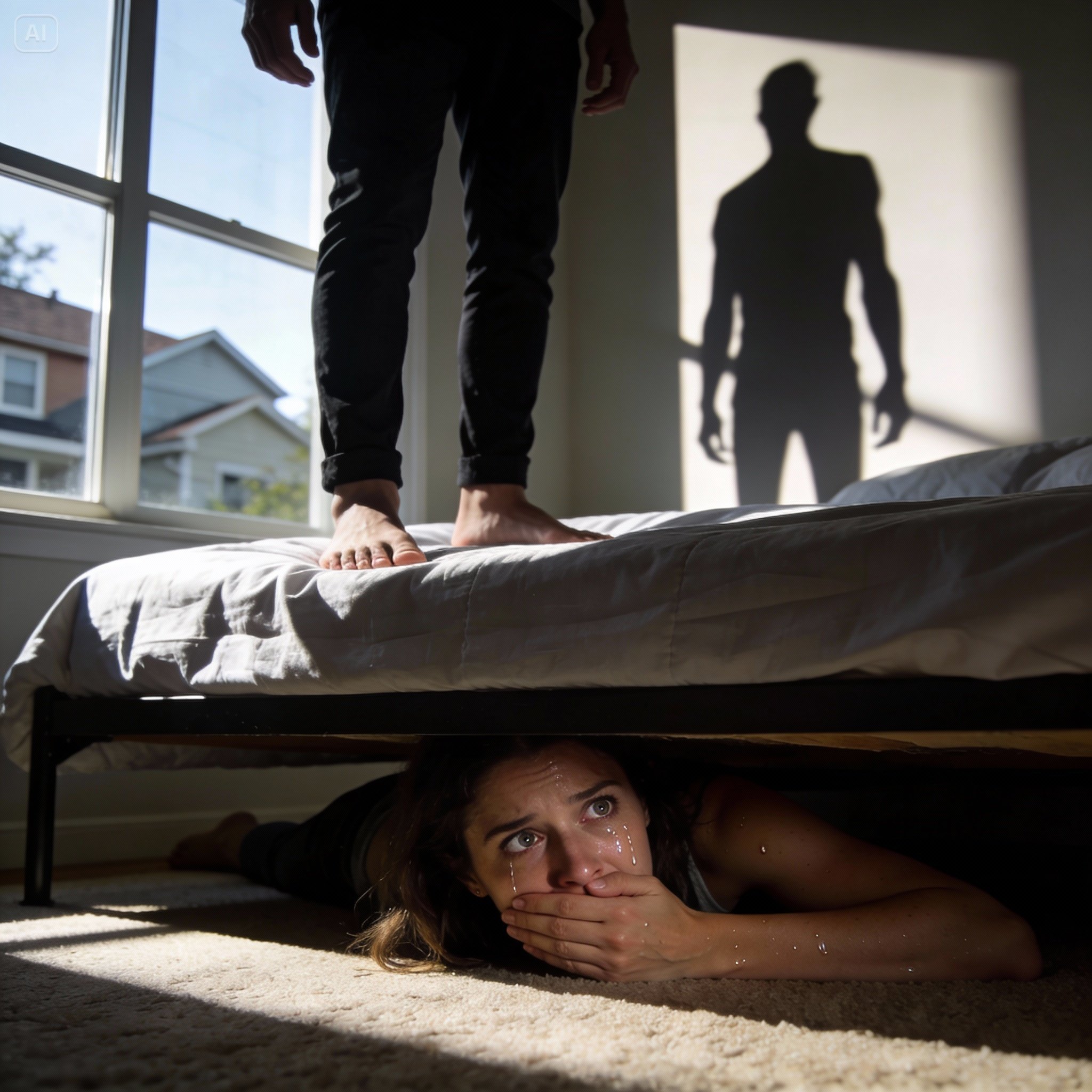
I went straight to the bedroom, locked the door behind me, and slid under the bed. Dust clung to my clothes. My phone was clutched tightly in my hand, ready to call 911 at the slightest sound.
Minutes stretched into an hour.
I almost convinced myself I had imagined everything.
Then, just after noon, I heard it.
The click of the front door unlocking.
Footsteps entered the house—slow, confident, familiar. Not sneaking. Not hesitant. Whoever it was moved like they belonged there.
Cabinets opened in the kitchen. Water poured into a glass. A chair scraped against the floor.
My heart pounded so violently I thought I might pass out.
The footsteps moved down the hallway.
They stopped outside my bedroom door.
The handle turned.
The door opened.
And then I heard a woman’s voice say softly, almost affectionately:
“I know you’re not supposed to be here yet.”
Under the bed, my entire body went rigid.
I watched as a pair of shoes stepped into view. Sensible flats. Clean. Ordinary.
She moved around my room—opened my dresser, touched my jewelry box, sat briefly on the edge of my bed.
Then she sighed.
“He never told you, did he?” she murmured.
That was when I understood.
This wasn’t a stranger.
This was someone who knew Mark.
My hand shook as I dialed emergency services, staying completely silent. When officers arrived minutes later, the woman didn’t run. She simply sat down and began to cry.
Her name was Elaine.
She was my husband’s sister.
A sister I had never been told about.
Mark had been estranged from his family for years—something he always brushed off as “complicated.” After his death, Elaine had discovered he still owned the house… and that no one else ever came home during the day.
She had been letting herself in, reliving memories, talking out loud to cope with her grief. The “screaming” my neighbor heard wasn’t violence—it was sobbing. Raw, uncontrolled grief echoing through empty rooms.
“I didn’t want to scare you,” she whispered through tears. “I just… wasn’t ready to let him go.”
I should have been furious.
Instead, I felt something unexpected.
Closure.
That night, after the police left, I sat alone in the living room and finally cried—not from fear, but from release. For two years, I had been trapped in silence, pretending I was fine, pretending grief had an expiration date.
It doesn’t.
But healing begins the moment you stop hiding from the truth—about others, and about yourself.
And sometimes, the thing you fear most isn’t danger…
It’s realizing you were never as alone as you thought.