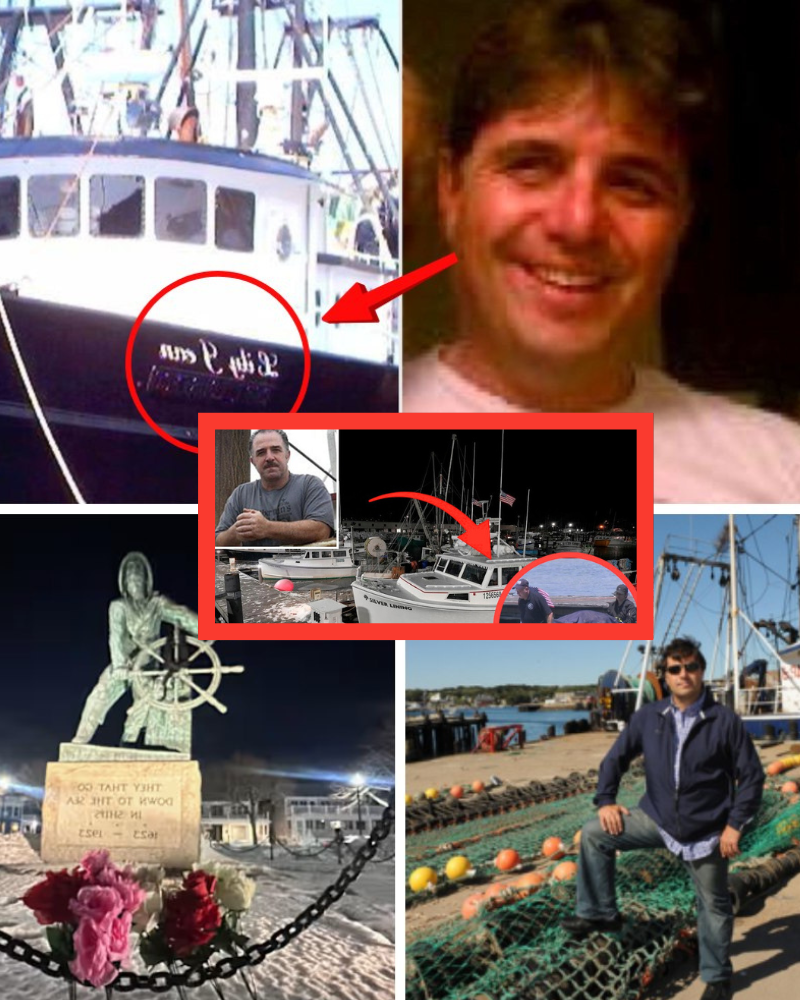
Just a few nautical miles from land, they were almost home. Gus Sanfilippo’s ship, laden with fish, was returning to port…but less than 20 minutes before docking, a storm struck, and the ship’s last signal was highly unusual. This clue led experts to a single hypothesis: what happened in those final moments?
Just a few nautical miles from land, Gus Sanfilippo’s ship was almost at the end of its journey. After days adrift in the harsh winter off the coast of Massachusetts, the hold was full of fish, the crew weary but carrying the familiar feeling of returning home. According to the navigation data, if everything went normally, in less than 20 minutes they would see the port lights. That was enough time to start thinking about a hot meal, about waiting family, about the moment of setting foot on shore after days facing the cold sea.
But it was precisely in that seemingly safest moment that things began to go off track. The weather changed abruptly, faster than predicted. A winter storm formed and swept through the area at a speed that left the warning systems barely able to react. The waves rose, the wind gusted fiercely, and temperatures plummeted to below freezing. For small and medium-sized vessels, this was the most dangerous scenario: too close to shore to turn back to the open sea, but not safe enough to seek shelter.

According to maritime communication records, the last signal from Gus Sanfilippo was recorded in an “abnormal” state. Not a complete distress call, not a clear SOS signal, but a series of intermittent data indicating that the electrical and engine systems may have suffered serious malfunctions. This immediately attracted the attention of experts, as it suggested that the incident did not occur gradually, but very quickly, so quickly that the crew did not have time to perform standard emergency procedures. Those familiar with the trade know that when a fishing vessel is returning to shore with a full hold, its weight increases significantly. This helps stabilize the vessel in moderate waves, but becomes a deadly disadvantage when encountering large, relentless waves. Just a momentary lapse in timing, a sideways wave in strong headwinds, and water can flood the deck at an uncontrollable speed. If the water pumping system or engine malfunctions simultaneously, the vessel will lose its ability to save itself for a few short minutes.
Maritime experts, after analyzing the data, have converged on a single hypothesis for those final moments: a “chain reaction of loss of control” scenario: sub-zero temperatures cause vents and pipes to freeze, reducing airflow; the engines are overloaded to combat headwinds and large waves; when the engines lose power or suddenly shut off, the vessel loses course and turns sideways relative to the waves. In that situation, just one more large wave would have sent water flooding the compartments so quickly that there wouldn’t have been time to send a complete distress signal.
The most crucial clue lies in the “unusual” nature of the last signal. If it were a gradual accident, the communication system would typically record multiple calls and repeated signals. But here, everything stopped almost instantly. This aligns with the hypothesis that the crew had only a few dozen seconds, or even just a few seconds, before the situation spiraled out of control. That’s far too short a time to think, too short to make decisions, and almost no chance of survival in the icy water.
The fact that the ship was so close to shore makes the story even more heartbreaking. In the human psyche, a distance of a few nautical miles is no longer an endless ocean, but rather “almost home.” This feeling sometimes makes decisions more difficult. Turning back to the open sea meant facing many more hours in the storm. Continuing toward shore was an instinctive choice: just a little further, just a little more. In maritime history, many tragedies have occurred precisely at the moment when “only a short distance remains.”
By the time rescue forces were deployed, the sea had left little trace. One body was found, an empty life raft drifted ashore, but the ship itself was not. This further reinforced the hypothesis that the accident happened very quickly and violently, leaving insufficient time for the entire crew to leave the ship in an organized manner. In the nearly freezing water, survival was measured in minutes, even seconds, not hours.
Gus Sanfilippo’s family later shared that he understood the sea, grew up by the sea, and had spent his entire life on such voyages. Therefore, the hypothesis of a single individual error was almost entirely ruled out. Instead, experts emphasize that a series of harsh natural events, coupled with an unforgiving timing, are the cause. The ocean doesn’t need a major mistake; sometimes, just a moment is enough.
The story of that ship is not just a personal tragedy, but also a chilling reminder of humanity’s fragility before nature. Even when “almost home,” the sea shows no mercy. It continues to…
He distinguished experience, not distance, and made no exception for a feeling of security. That’s what made the final clue – that unusual signal – key to understanding that in those final moments, it wasn’t subjective judgment, but the ruthless speed of the disaster that decided everything.
And perhaps, the most haunting question for those who remained wasn’t just “what happened,” but “would the outcome have been different if it had been a few minutes earlier or later?” When the ship was only a few nautical miles from land, the line between return and loss turned out to be incredibly thin.
Để lại một bình luận