Some folks say home is where you hang your hat, but in the West, home was where someone waited for you to come back.
That was something Rose Whitmore no longer had.
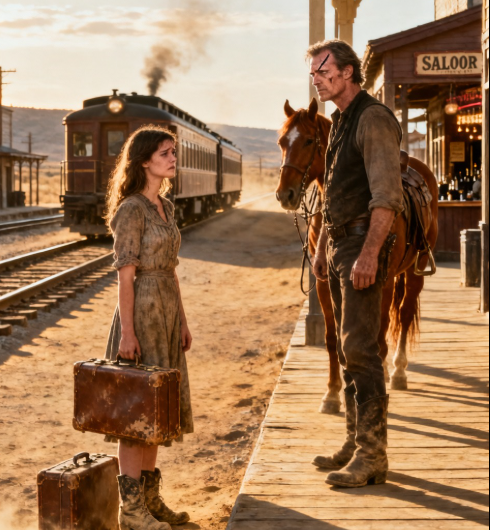
She stepped off the last train into Copper Creek with dust on her boots, a worn valise in her hand, and nothing left except hope that was fading fast.
For 3 days, she had begged for work.
The boarding house pushed her out.
The laundry said no.
The general store would not even let her finish her sentence.
Folks did not trust a woman alone.
Folks did not trust anything out of the ordinary.
And Rose, with her eastern accent and no kin to speak for her, was as out of place as a sparrow in a wolf den.
But losing her money was what broke her spirit most.
$47.
Two years of saving in Lowell’s mills, gone to a swindler named Hector Finch, who had written warm letters, promised marriage, and vanished the moment she reached Wyoming.
She had nothing now, no job, no money, no place to sleep.
But she stood on the empty platform as the train rolled away, dragging its shadow like a long black ribbon across the dust.
That was when she heard it.
Slow, heavy footsteps on the wooden boards.
The kind of steps that made a whole street hold its breath.
The men at the water trough stopped talking.
An old fellow on the porch stepped back inside without a word.
Even the horses pinned their ears.
Rose lifted her head.
A man walked out of the saloon leading a chestnut horse.
He was tall, broad-shouldered, eyes the cold color of winter creek water, a scar cut through one eyebrow.
His jaw was dark with unshaved stubble.
He did not look angry.
He did not look anything.
He was the kind of man folks feared because no one knew what lived behind his silence.
Bo Callahan.
Rose had heard the whispers.
He was trouble, the kind a decent woman stayed far from, but desperation pushes a person toward strange courage.
Before she could think, she stepped into his path, but the horse snorted and tossed its head.
Bo steadied it with one hand, but never took his eyes off her.
Up close, he looked even harder, like granite carved by wind and years.
“Mister,” Rose said.
Her voice shook, but she kept going.
“I ain’t asking for charity. I’m offering a deal.”
He did not blink.
Did not shift.
Just watched her like she was a stray blocking the road.
“I can cook,” she said.
“I can clean. I can mend clothes. I just need a roof. That’s all.”
Still nothing.
Yet she could feel every stare in the street pressing on her back.
Bo finally spoke.
His voice was rough, low, like gravel sliding over wood.
“You don’t know me.”
“No, sir,” Rose answered.
“But I know I got nowhere else to go. And you look like a man who ain’t planning to stay here long.”
Something flickered in his eyes.
Quick and unreadable.
Not kindness, but not refusal either.
He looked toward the boarding house where Mrs. Henley hid behind a curtain.
Then he looked at Rose’s hands, calloused and scarred from mill work.
The kind of hands that knew labor.
“There’s a meal house across the street,” he said.
“I’ll buy you supper. You tell me your story. Then we’ll see.”
He walked off without waiting for her.
Inside the meal house, the air smelled of bacon grease and boiled beans.
Four tables, flies tapping at the window.
Bo sat in the darkest corner.
He ordered two bowls of navy bean soup without asking her preference.
She waited until he lifted his spoon before touching hers.
He noticed, said nothing.
“Name’s Bo,” he said between bites.
“Bo Callahan.”
“Rose. Rose Whitmore.”
He repeated her name slowly.
She told him everything.
The mills back east, her husband Thomas dying from typhoid, saving every penny, the newspaper ad, Hector Finch’s soft words, the hard truth of being fooled.
When she finished, her hands lay flat on the table.
She did not lift her eyes.
Bo looked at her for a long moment.
“You got family back east?”
“None that want me.”
“Friends?”
“Not anymore.”
He wiped the last of the soup with a piece of bread.
“Place I got is 2 hours out,” he said.
“Cabin my ma built with my pa. She passed 2 years ago. I’ve been there alone since.”
Rose held her breath.
She waited.
“I ain’t looking for a wife,” he said.
“Not the way you mean. But I could use someone to keep house. Cook. Tend what my ma left behind.”
He met her eyes.
“And in return you get a roof, food, and in my name if you need it.”
Rose swallowed hard.
“Why?”
“You don’t know me.”
Bo looked down at his hands.
The large scarred knuckles, the rough palms.
Then he spoke again.
“My ma came out here same as you. Answered an ad. Traveled halfway across the country to marry a stranger.”
“Guide to reading the full story in the comments section 
Để lại một bình luận