The Old West had a way of breaking a person before it ever bothered to test them. It wasn’t the gunfights or the dust storms or the long miles between towns. It was the quiet moments, the ones where a man had to choose whether to turn away or step forward.
This story begins on one of those moments, a moment nobody in Millerton would forget. The afternoon sun hung heavy over the depot. Heat shimmered on the rails.
Wyatt Sans stood in the thin shade, a crate of barbed wire by his boots, but wishing the 215 from Cheyenne would hurry. He didn’t like being watched. And folks in town always watched him, never directly, always sideways, like a man watching a rattler he hoped wouldn’t strike.
The whistle finally echoed across the plains. People straightened. A few ladies adjusted their bonnets. The station master checked his watch, even though he already knew it was slow. The train pulled in with a blast of steam that sent dogs running under wagons.
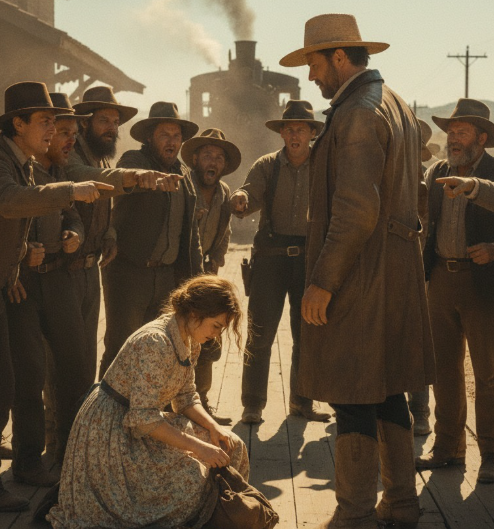
Five passengers stepped down, but it was the last one who made the whole platform go quiet. She came off slow, one hand gripping the rail, the other clutching a worn carpet bag. Her calico dress was faded, her bonnet ribbon torn. Dust clung to her hem as if life had been dragging her by the ankles. Her eyes searched the crowd with a hope so small it almost hurt to look at.
That was Clara Brennan.
Before she could call her own name, Hyram Cadell pushed through the crowd. Big man, big mouth, bigger pride.
“You Clara Brennan?” he asked, looking her over like she was livestock, her chin lifted.
“I am. You bring the $500 and the sewing machine?”
Clara swallowed. “My father passed. There’s nothing left, but—”
Cadell cut her off with a laugh, loud enough to turn heads. “Then you ain’t worth the price of your ticket.”
He kicked her carpet bag off the platform. It burst open in the dirt. Her night dress, a Bible, a tintype of two stern parents, and a cracked wooden sewing box spilling spools of thread like little wheels running away.
People laughed. Real laughter, the ugly kind.
Clara knelt in the dust, gathering what little she owned with shaking hands. Someone behind her made a remark about other work she could find at the Silver Dollar. More laughter followed.
Wyatt felt something twist inside his chest.
Mrs. Pedigrew called out, “Shameful, leading a man on like that.”
Clara kept her head down while her fingers trembled so hard the spools rolled from her grasp. The crowd watched like it was a show meant for Sunday afternoon entertainment.
Wyatt bent to pick up his crate. Then he set it back down. He stepped forward, pulled off his hat, and said the words that froze every soul on the platform.
“I’ll take her.”
Silence, pure and complete.
Sheriff Burl squinted. “Wyatt, you ain’t the marrying kind.”
“Didn’t say marry.” Wyatt glanced at Clara. “Said I’ll take her if she’ll come.”
Clara stared at him like she wasn’t sure he was real. Dust streaked her cheeks. Her hands clutched her broken sewing box. Her voice shook when she whispered, “Yes.”
Wyatt lifted her spilled belongings one by one—thread spools, Bible, tintype—without once looking at the crowd. They parted for him like he carried fire in his hands.
He helped Clara onto his buckboard, climbed beside her, and flicked the reins. Mrs. Pedigrew gasped loud enough for heaven to hear, but Wyatt never looked back.
They left Millerton behind, rolling into the golden stretch of prairie, where only wind and sky cared enough to listen.
For three miles, neither of them spoke. Clara held her carpet bag tight against her chest. Wyatt kept his eyes on the road. The sun beat down, the wheels creaked, and somewhere a hawk circled low.
At the fourth mile, Clara asked, “Why?”
“Seemed like you needed help,” Wyatt said.
“You don’t know me.”
“Know enough.”
She stared at him a long time—at his weathered jaw, his steady hands, his eyes that didn’t dart away like the others.
“What do you want from me?”
“Nothing you ain’t willing to give.”
Another mile passed before she said, “Why would you do this?”
Wyatt didn’t answer for so long she thought he wasn’t going to. Then he said quietly, “I know what it’s like to be judged.”
The cabin came into view on a small hill. Smoke drifted from the chimney. A fencing circled six red-faced cattle. A patch of garden struggled against the prairie wind. It wasn’t much, but it was standing.
Wyatt helped her down from the wagon, opened the door for her. She stepped inside the dim light. One room, a stone fireplace, a rope bed, a table with two chairs. Dust and coffee grounds gave the air a tired smell.
“You take the bed,” Wyatt said. “I’ll sleep by the fire.”
“I can’t.”
“Already decided.”
He laid his bedroll on the floor, though.
She sat stiffly on the edge of the rope bed, hands twisting in her lap. Outside, a coyote cried. Inside, the fire crackled against the stone. Night settled slow and heavy.
Clara lay on the corn husk mattress, still in her worn dress. Wyatt lay 3 ft away on the floor, staring at the rafters. His breathing was steady, but not steady enough to fool her. He was awake. So was she. Neither moved. Neither spoke.
Between them, the quiet grew thick as rope.
And for the first time since the train whistle blew, Clara felt something she hadn’t dared feel in a long while.
“Guide to reading the full story in the comments section
Để lại một bình luận