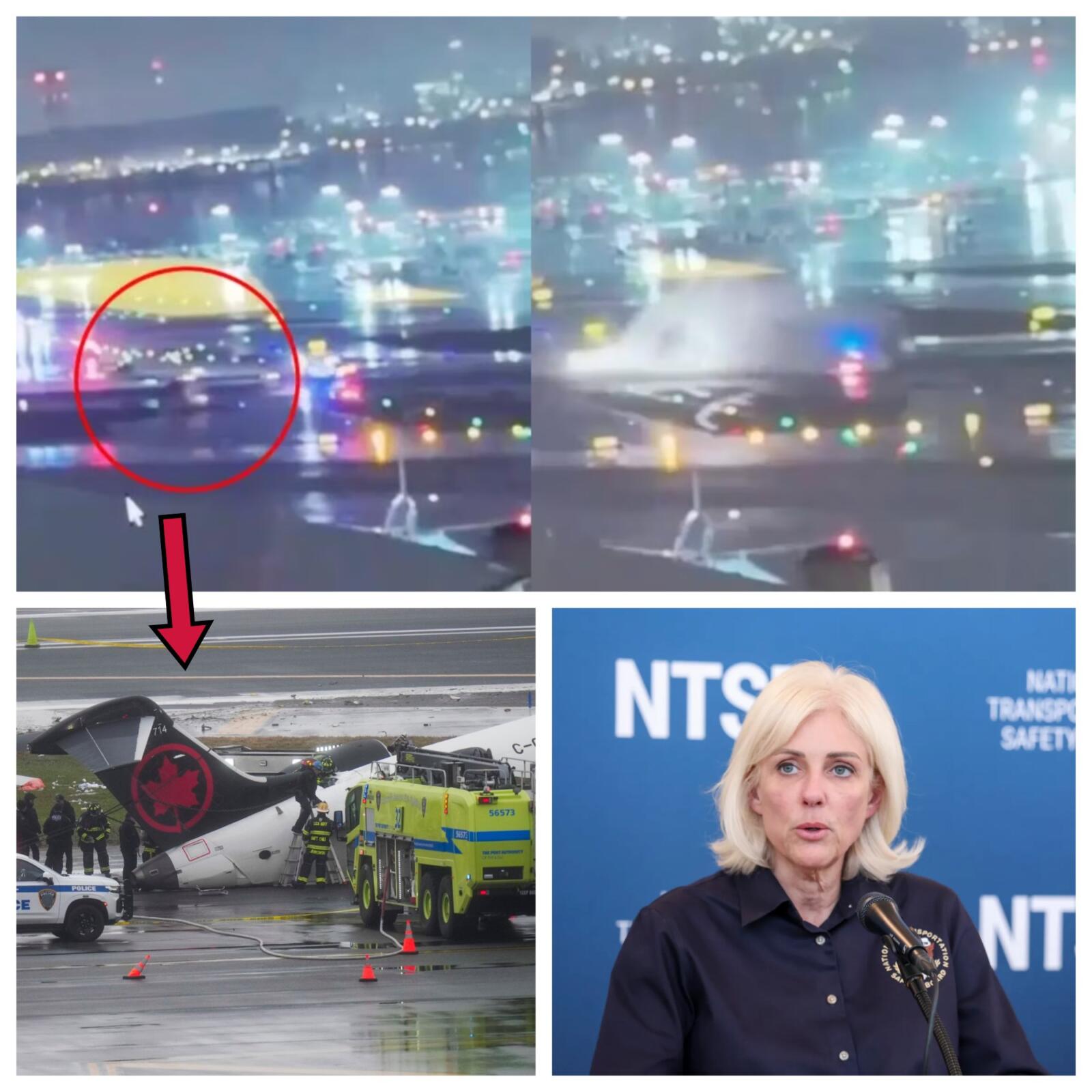
What was supposed to be an ordinary landing has now turned into one of the most disturbing aviation revelations in recent memory — and the latest findings are raising a terrifying question:
Was this tragedy completely preventable?
In a bombshell update, Jennifer Homendy, chair of the National Transportation Safety Board (NTSB), has revealed the shocking reason why a critical runway warning system at LaGuardia Airport failed to alert controllers — just seconds before a catastrophic collision between an Air Canada jet and a fire truck.
The warning that never came
According to investigators, the airport’s advanced surface detection system — designed to immediately flag dangerous runway conflicts — never issued an alert.
Not a sound. Not a signal. Nothing.
And now, officials say they know why.
The fire truck involved in the incident was reportedly not equipped with a functioning transponder — a device that allows vehicles to be tracked by air traffic control systems in real time.
Without it, the truck was effectively invisible.
Invisible on the runway
That single missing piece of equipment may have had devastating consequences.
As the Air Canada aircraft approached the runway, the system that should have screamed “DANGER — RUNWAY OCCUPIED” remained silent. Air traffic controllers, relying on automated alerts as a critical safety layer, received no warning that a vehicle was directly in the jet’s path.
Moments later, disaster struck.
The aircraft collided with the truck in a violent impact that killed two pilots and left investigators scrambling to understand how such a failure could occur at one of the nation’s busiest airports.
“A catastrophic breakdown”
Speaking to reporters, Homendy did not hold back.
“This was a catastrophic breakdown in layered safety protections,” she said, emphasizing that aviation systems are designed with redundancy precisely to prevent this kind of tragedy.
But in this case, one silent failure appears to have erased an entire line of defense.
Questions that demand answers
The revelation has ignited outrage and disbelief across the aviation community:
- Why was the fire truck operating on an active runway without a transponder?
- Were there manual safeguards that should have caught the danger?
- And most chilling of all — how many seconds of warning were lost?
Experts say even a brief alert could have made the difference between life and death.
A tragedy under intense scrutiny
The NTSB has now launched a full-scale investigation into equipment protocols, airport procedures, and whether safety regulations were properly followed.
Meanwhile, families of the victims are left grappling with an unbearable possibility:
that this devastating collision may never have happened if a single device had been working.
As more details emerge, one haunting truth is becoming impossible to ignore:
The system designed to protect everyone… stayed silent when it mattered most.
Để lại một bình luận