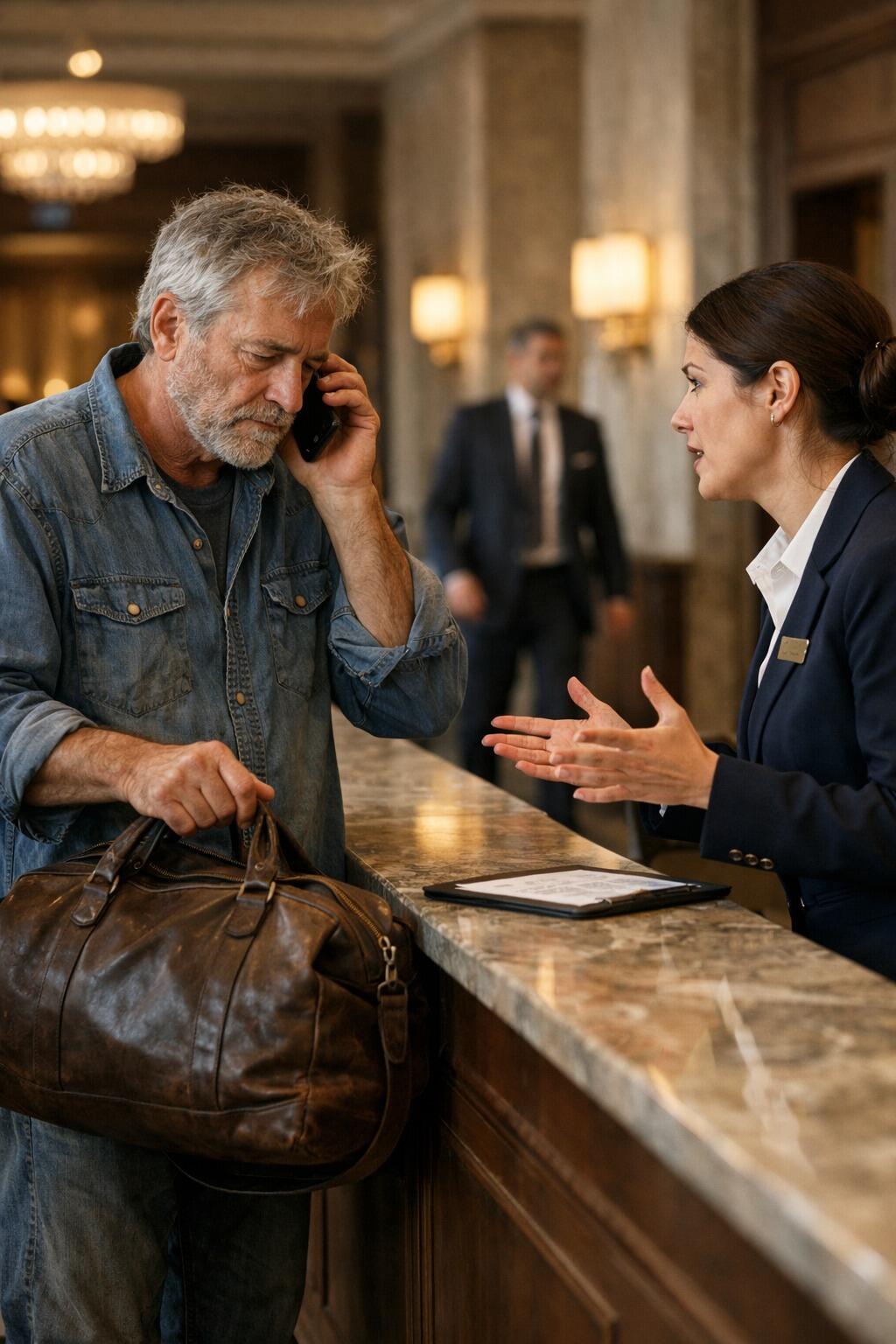
Late one afternoon, a man in his fifties walked into the gleaming lobby of a five-star hotel in downtown Chicago.
The marble floors reflected crystal chandeliers. Soft music floated through the air. Guests in tailored suits and elegant dresses moved confidently across the room.
And then there was him.
His skin was darkened by years under the sun. His hands were rough, his posture slightly bent from long days of labor. He wore a faded brown shirt, old trousers, and a pair of worn-out slippers that looked as though they had survived many harvest seasons.
At first glance, anyone could tell he was a farmer.
He paused near the entrance, took a breath, and slowly walked toward the reception desk.
“Madam,” he said gently, his voice calm and respectful, “I would like to make a reservation for tonight.”
The receptionist barely hid her irritation as her eyes swept over him—from his dusty clothes to his cracked slippers. Her perfectly groomed smile disappeared.
“Sir,” she replied coolly, “this is a five-star hotel. Our rooms are very expensive. I don’t think this place is suitable for you.”
The farmer nodded politely. “I understand,” he said softly. “But I would still like to stay here. Any room will do.”
Her lips tightened.
“Listen,” she said, lowering her voice but sharpening her tone. “This hotel is for high-level businessmen and distinguished guests. You should look for a cheaper place outside the city.”
The conversation began to draw attention.
A few guests glanced over with curiosity. Some whispered. One man smirked, clearly amused by the idea of a farmer trying to stay in such a hotel. Others felt a flicker of sympathy but said nothing.
The farmer stood quietly, his hands clasped in front of him.
For a moment, it seemed as though he might turn and leave.
But instead, he lowered his head, reached calmly into his pocket, and pulled out a brand-new smartphone—its screen gleaming under the lobby lights.
The receptionist scoffed silently, already turning away.
Then the farmer made a call.
His voice was steady. Calm. Certain.
“Hello,” he said. “I’m standing in your hotel lobby right now.”
He paused, listening.
“Yes… the Chicago location.”
Another pause.
“I was hoping to stay tonight, but it seems my presence is… inconvenient.”
The elderly security guard nearby stiffened slightly. Something about the man’s tone felt different now—measured, controlled, powerful.
The farmer nodded slowly as he listened to the voice on the other end.
“I see,” he said. “Thank you. I’ll wait.”
He ended the call.
Five minutes passed.
Then the lobby doors burst open.
A man in an expensive suit hurried inside, panic written across his face. It was the hotel’s general manager.
His eyes scanned the room until they landed on the farmer.
The color drained from his face.
He rushed forward.
“Mr. Alvarez!” the manager exclaimed, bowing slightly. “I’m terribly sorry. I didn’t realize you were arriving today.”
The lobby fell completely silent.
The receptionist froze.
Guests stopped moving.
Mr. Alvarez—the quiet farmer—smiled faintly.
“I didn’t announce my visit,” he said calmly. “I wanted to see how my guests are treated when they don’t look… impressive.”
The manager swallowed hard.
“Sir,” he said, turning sharply toward the receptionist, “do you know who this is?”
She shook her head, pale and trembling.
“This man,” the manager continued, “is the majority shareholder of this hotel chain. He owns thousands of acres of farmland across three states. And he personally funded the expansion of this very building.”
The receptionist’s legs nearly gave out.
Mr. Alvarez looked around the lobby, his gaze gentle but piercing.
“I grew up poor,” he said quietly. “I worked the land with my bare hands. These slippers”—he glanced down at his feet—“remind me where I came from.”
He turned to the receptionist.
“Luxury is not marble or chandeliers,” he said softly. “It is dignity. And today, you forgot that.”
The manager bowed again. “Your suite is ready, sir. And… please accept our deepest apologies.”
Mr. Alvarez nodded.
As he walked toward the elevator, the guests who had laughed earlier lowered their eyes in shame.
The elderly security guard smiled.
And the lobby—once filled with judgment—remained silent long after the farmer in worn-out slippers disappeared from sight.
Because true wealth doesn’t announce itself.
And respect should never depend on appearances.
Để lại một bình luận