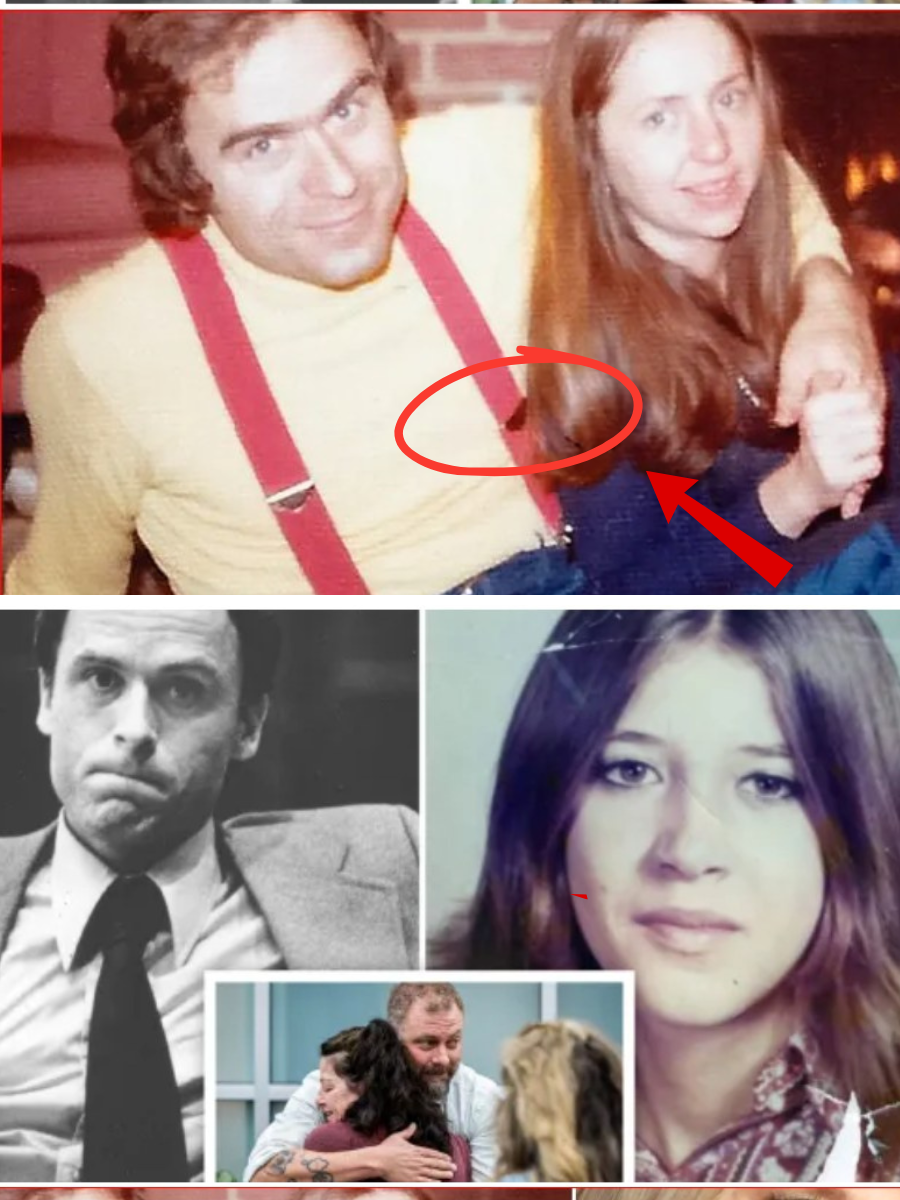
A chilling new chapter in one of America’s most infamous serial killer sagas has just been written. Nearly fifty years after her brutal murder, 17-year-old Laura Ann Aime has officially been confirmed as a victim of Ted Bundy—and the details emerging from her family are more disturbing than anything previously known. What was long suspected has now been proven: the charming, clean-cut law student didn’t simply snatch her off the street like so many others. He stalked her. He approached her multiple times at school. And in one documented encounter, he even pretended to be her boyfriend—sliding his arm around her shoulders to “protect” her from classmates throwing leaves down her shirt—before ultimately beating her, strangling her with a nylon stocking, and dumping her naked body in a remote canyon.
The revelation, confirmed by Utah authorities on April 1, 2026, has sent fresh shockwaves through the families of Bundy’s known victims and reignited public fascination with the monster who confessed to over 30 murders but is believed by experts to have claimed more than 100 lives between 1974 and 1978. For Laura’s niece, Taura Stucki, 30, the confirmation arrived through a private investigator’s files that painted a picture far darker than the random abduction narrative long accepted by investigators. “It seems that Ted Bundy actually stalked my aunt a few times before actually killing her,” Stucki told The U.S. Sun in an exclusive interview. “He approached her multiple times… These kids were throwing leaves down her shirt. He came up to her and put his arm around her and was like, ‘Leave my girlfriend alone.’ [Laura] looked at him and was like, ‘I’m not your girlfriend.’”
That calculated, predatory move—posing as a protective boyfriend to insert himself into her world—stands out even in Bundy’s long history of manipulation. The killer was a master at feigning injury, wearing fake casts, or pretending to be a police officer to lure trusting young women into his Volkswagen Beetle. But the new evidence suggests he invested time in Laura, watching her at school, testing boundaries, and building a false sense of familiarity before striking on Halloween night 1974. It humanizes the horror in the most terrifying way possible: this wasn’t a lightning strike of evil. It was a slow, deliberate hunt.

Laura Ann Aime was just 17, the eldest of four children raised on a farm in Lehi, Utah, about 25 miles south of Salt Lake City. Described by family as a free-spirited, six-foot-tall force of nature with an “Amazonian work ethic,” she rode horses, competed in barrel racing, and once carried two-gallon paint buckets up ladders without complaint. Her father’s favorite, she brought home a deer on her lap after a hunt and bore the scars of a brutal fall from her horse into barbed wire—scars that would later become the heartbreaking way her body was identified. “She was really hard-working,” Stucki recalled. “My mom would always talk about just how strong Laura was.”
On October 31, 1974, Laura left a Halloween party alone just after midnight, telling friends she was heading to a nearby store. Witnesses saw her trying to hitchhike—a common, carefree practice among young people in the 1970s that Bundy exploited ruthlessly. She was never seen alive again. Two months later, on November 27, hikers stumbled upon her nude body along Route 92 near American Fork Canyon, roughly eight miles from Lehi. She had been savagely beaten, suffering multiple brain contusions and a fractured skull. A nylon stocking was still wrapped around her neck. She wore only a necklace. Her body had been partially covered with leaves, twigs, dirt, and mud in what appeared to be a hasty attempt to conceal her.
Her grandfather identified her through that distinctive barbed-wire scar. The family always harbored a quiet certainty that Bundy was responsible, especially after his 1975 arrest and the emerging pattern of his Utah killings. But official confirmation only came decades later through advanced investigative work, including DNA or case-file cross-referencing that finally linked her to the monster. At a news conference on April 1, Utah County Sheriff’s Deputy Jake Hall embraced Laura’s youngest sister, Tommi Aime, as the announcement was made public. The moment was raw, emotional, and long overdue for a family that had lived with uncertainty for half a century.
What makes Laura’s story uniquely haunting is the glimpse into her own premonition of death. Stucki revealed that her aunt seemed to sense her fate long before that Halloween night. Laura repeatedly asked her sister Evelyn (Taura’s mother) to play the song “Seasons in the Sun” at her funeral, calling it an “old lady song” when teased about it. “There is this song, The Seasons in the Sun, and she would be like, ‘Evelyn, play this at my funeral when I die,’ and my mom’s like, ‘That’s an old lady song, you’re not going to die,’” Stucki recounted. Even more eerily, Laura told her parents not to bury her in a dress but in a nightgown. “I think she just always knew,” her niece said. “I would like to think that… instead of bringing negativity into it. It’s God’s plan. That’s given us peace.”
Bundy, then a University of Utah student, had already claimed at least two victims in the region before Laura. He operated with chilling efficiency in Utah, Colorado, and Idaho during that period, often targeting young women who fit a similar profile—long hair, parted in the middle, college-aged or slightly younger. Laura’s case fits the pattern perfectly, yet the stalking element adds a layer of premeditation that feels even more personal and calculated. Bundy didn’t just kill; he studied, approached, and infiltrated his victims’ lives before striking. The private investigator’s files, handed over to the family, finally confirmed what Laura’s relatives had long suspected: she wasn’t a random target. She was chosen.
The broader Bundy timeline is a grim catalog of terror. By the time he was executed in Florida’s electric chair in January 1989, he had confessed to over 30 murders, though many experts believe the true number exceeds 100. His known victims from 1974 alone include Lynda Ann Healy, Donna Gail Manson, Susan Elaine Rancourt, Roberta Kathleen Parks, Brenda Carol Ball, Georgann Hawkins, Janice Ann Ott, Denise Marie Naslund, Nancy Wilcox, Melissa Anne Smith, and Debra Jean Kent—most of them snatched in the Pacific Northwest or Mountain West. Laura Ann Aime’s name now sits officially alongside them, closing one more painful chapter for her family while reopening old wounds for the dozens of other families still waiting for answers.
For Taura Stucki, living with this legacy has been a lifelong shadow. “I didn’t know this was something so crazy,” she admitted. “But it’s definitely chilling. It’s a sickening feeling to think that she was so young, bless her heart. I have a daughter, so it’s hard to feel [that]. I could never wish anything like that to ever happen to anyone.” Her words carry the weight of generational trauma—the kind that doesn’t fade with time but evolves into quiet resilience and a fierce determination to remember the victim, not just the killer.
The confirmation also highlights the power of modern investigative tools. Cold cases once thought unsolvable are being cracked through DNA advancements, digital archives, and persistent private investigators. Bundy’s victims, long reduced to grainy photos and names on lists, are being given back their full stories. Laura emerges not as another statistic but as a vibrant, hardworking farm girl who barrel-raced, hunted deer, and carried paint buckets like they weighed nothing. A girl who loved deeply, worked hard, and somehow sensed the darkness closing in around her.
Yet the horror lingers in the details Bundy left behind. The way he casually inserted himself into her schoolyard moment, arm around her shoulders, playing the hero. The way her body was found beaten and exposed, covered hastily with forest debris. The way her family had to identify her not by face but by a childhood scar. These aren’t abstract facts—they are visceral reminders of how close evil can get, how it can smile, flirt, and pretend to protect before destroying everything.
As the Aime family processes this official acknowledgment, they do so with the same quiet strength Laura herself embodied. They speak of God’s plan, of peace through faith, of choosing optimism over bitterness. But beneath the grace lies an unshakeable truth: a 17-year-old girl was stalked, abducted, beaten, strangled, and discarded like trash by one of history’s most notorious predators. Her story deserves to be told not just as part of Bundy’s monstrous tally, but as the heartbreaking tale of a young woman whose light was stolen far too soon.
The revelation arrives at a time when true-crime fascination continues to grip the public. Documentaries, podcasts, and streaming series revisit Bundy’s crimes with almost obsessive detail. Yet for the families, these are not entertainment—they are lived trauma. Laura Ann Aime’s case reminds us that even decades later, the monster’s shadow still reaches into the present. New details still surface. New pain still surfaces. And new resolve to honor the victims, not glorify the killer, grows stronger with every confirmation.
In the end, Laura Ann Aime was more than Bundy’s victim number whatever-she-was. She was a daughter, a sister, a barrel racer, a deer hunter, a paint-bucket carrier, and a girl who once asked for a nightgown instead of a dress at her funeral. She was someone who, against all logic, seemed to know her time on earth would be brief. Now, nearly 52 years after her murder, her family finally has the official truth they always carried in their hearts. Ted Bundy killed her. He stalked her first. And in doing so, he left behind a legacy of terror that still demands we never forget the names—or the faces—of the lives he destroyed.
The canyon where her body was found remains a quiet place today, but for the Aime family, it will forever echo with the memory of a vibrant 17-year-old who should have lived to see many more Halloweens. Her story, now fully told, stands as both a warning and a tribute: evil can wear a handsome face and a charming smile, but the truth, no matter how long it takes, will eventually come to light. Laura Ann Aime’s name is no longer just another entry on a killer’s list. It is a reminder that every victim was someone’s whole world—and that their stories deserve to be heard, remembered, and honored long after the monster is gone.
Để lại một bình luận