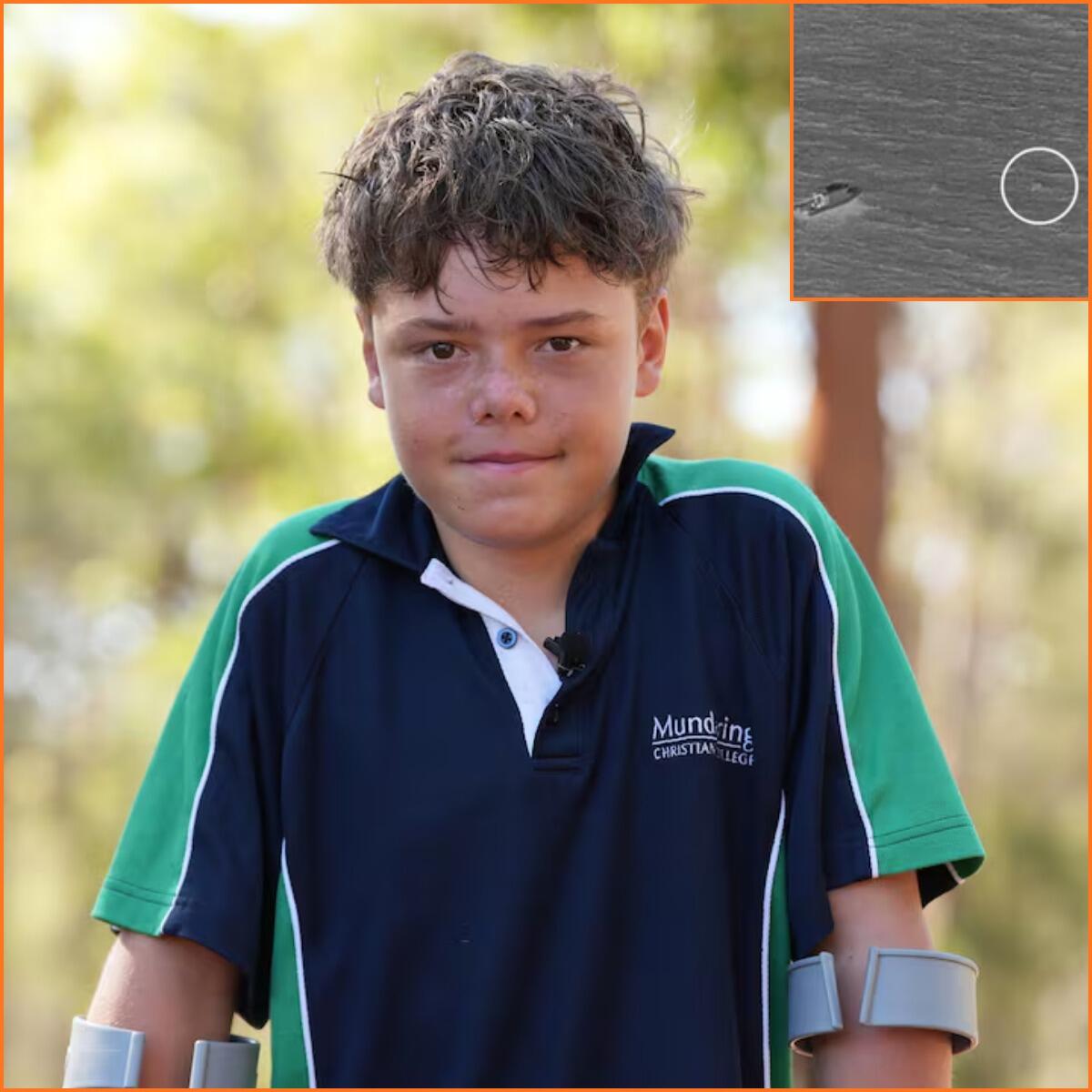
The Appelbee family’s near-tragedy off the coast of Western Australia has gripped the nation, with mother **Joanne Appelbee** describing the moment she sent her 13-year-old son Austin alone into the churning ocean as “the hardest decision of my life.”
It was meant to be a perfect final day of summer holidays. On Friday, January 30, 2026, Joanne Appelbee, 47, and her three children—Austin, 13, Beau, 12, and Grace, 8—headed to Quindalup Beach in Geographe Bay, about 250 kilometers (155 miles) south of Perth, for a fun outing on rented inflatable paddleboards and a kayak. The conditions initially seemed ideal: calm waters, clear skies, and the family enjoying themselves close to shore.
But within a short time, strong winds and powerful currents turned the afternoon into a nightmare. The family was suddenly swept far offshore, drifting helplessly as the kayak began taking on water and the paddleboards proved impossible to control against the building waves. They found themselves approximately 4 kilometers (2.5 miles) from the beach, then farther as the drift continued.
With no immediate rescue in sight and the situation rapidly deteriorating, Joanne faced an agonizing choice. She could not abandon her younger children—Beau and Grace were frightened and clinging to her and the boards—yet someone had to try to reach shore and alert authorities. She knew Austin was the strongest swimmer in the family, having grown up comfortable in the water from a young age. In a moment that still haunts her, she asked her eldest son to leave them and swim for help.
“I knew he was the strongest and he could do it,” Joanne later told the ABC. “I would have never gone because I wouldn’t have left the kids at sea, so I had to send somebody.” She described the instant as “one of the hardest decisions I have ever made,” her voice cracking with emotion in interviews. As Austin began his swim, one relentless question echoed in her mind: “What have I done?”
Austin initially tried to paddle back using the kayak, but it soon became swamped. Left with no alternative, he ditched the vessel and started swimming toward the distant shoreline. For the first two hours, he kept his life jacket on, battling massive waves and growing exhaustion. Realizing the jacket was slowing him down and making progress harder, he made the courageous decision to remove it—swimming the remaining distance without buoyancy in rough, cold seas.
“There were moments I wanted to give up,” Austin recounted in interviews with the BBC and ABC News. “The waves are massive and I have no life jacket on. I was really scared.” Yet he kept pushing forward with a single, defiant mantra repeating in his head: “Not today. Not today. Not today.” He switched between breaststroke, freestyle, and survival backstroke, refusing to surrender. After nearly four hours of relentless effort, Austin finally reached the beach. Exhausted, legs buckling beneath him, he collapsed on the sand.
But he didn’t stop. Barefoot and drained, Austin ran another 2 kilometers (1.2 miles) to the family’s accommodation, retrieved his mother’s phone, and called emergency services around 6 p.m., providing vital details about their location and condition. His quick thinking triggered a large-scale rescue involving Naturaliste Marine Rescue, police, and a helicopter.
Meanwhile, Joanne, Beau, and Grace endured more than eight—possibly up to 10—hours adrift, clinging desperately to the paddleboards as night fell and temperatures dropped. They drifted as far as 14 kilometers (about 8.7 miles) offshore. Joanne later admitted she feared Austin hadn’t made it, her heart breaking with every passing minute. Finally, around 8:30 p.m., the rescue helicopter spotted them. All three were winched to safety, treated for minor injuries and hypothermia, but otherwise unharmed.
Rescuers described Austin’s feat as “superhuman.” Naturaliste Marine Rescue commander Paul Bresland praised the teenager’s endurance, noting the extraordinary physical and mental strength required to swim roughly 4 kilometers in such conditions—especially after removing his life jacket.
In the aftermath, Austin has remained humble. Speaking to the BBC, he said simply, “I don’t think I am a hero. I just did what I did.” Yet the community and media have hailed him as a real-life hero, with tributes flooding social media praising his courage, resilience, and selflessness. Joanne has spoken of her immense pride and relief, emphasizing how the ordeal has brought the family even closer together.
The incident has sparked renewed warnings about water safety in Western Australia’s popular coastal areas. Authorities stress the need to check forecasts, stick to patrolled beaches, carry emergency communication devices, and understand how quickly conditions can change—even on seemingly perfect days.
For the Appelbee family, the story is one of unbreakable love and determination. Joanne’s agonizing decision, Austin’s refusal to quit, and the eventual arrival of rescue have turned what could have been a tragedy into a testament to human spirit. What happened next—after Joanne’s hardest choice—was nothing short of miraculous: a 13-year-old boy’s four-hour swim brought help, reunited the family, and reminded everyone that courage can overcome even the most terrifying odds.
Để lại một bình luận