I was six years old when my parents died in a car accident.
One moment, I had a family. The next, I had silence—thick, confusing, and permanent. The world became enormous, harsh, and hollow overnight.
Then there was my grandmother.
She didn’t hesitate. She took me into her small house, held my hand, and quietly rebuilt my life piece by piece. She became my anchor, my shelter, the one person who made the world feel safe again.
Her house always smelled like cinnamon, old books, and laundry soap. She worked endlessly but spent nothing on herself. Her sweaters were threadbare. Her shoes were patched again and again. Every dollar she earned went to me—school supplies, doctor visits, warm meals, and small surprises she pretended were nothing.
She made pancakes for dinner when money was tight. She stayed up late helping me with homework even when exhaustion weighed her eyelids down. At night, she read to me in a soft voice until I fell asleep, her finger tracing the lines of the book when her eyes could barely stay open.
We were inseparable.
People often mistook us for mother and daughter instead of grandmother and granddaughter. I had friends, but she was my closest companion. We shared secrets, silly traditions, and Sunday afternoons with sweet tea and card games she always let me win.
But as I grew older, I wanted more.
When I was fifteen, I asked her for a car.
“Grandma, please,” I begged. “Everyone has one.”
She looked at me for a long moment, then shook her head gently.
“Not yet, sweetheart. There are more important things to save for.”
I exploded.
I slammed doors. I sulked. I refused to speak to her for hours. In my teenage mind, she was cheap. Unfair. Out of touch. I told myself she didn’t understand what it meant to feel left behind.
She never raised her voice. She only knocked softly on my door that night and said,
“One day, you’ll understand.”
I didn’t.
Not then.
Only a few days later, she was gone.
A sudden stroke. No warning. No goodbye.
The house felt lifeless after that—silent, empty, unbearably cold. Her chair sat untouched. Her sweater still hung by the door. I kept waiting to hear her footsteps in the kitchen, the kettle boiling, her voice calling my name.
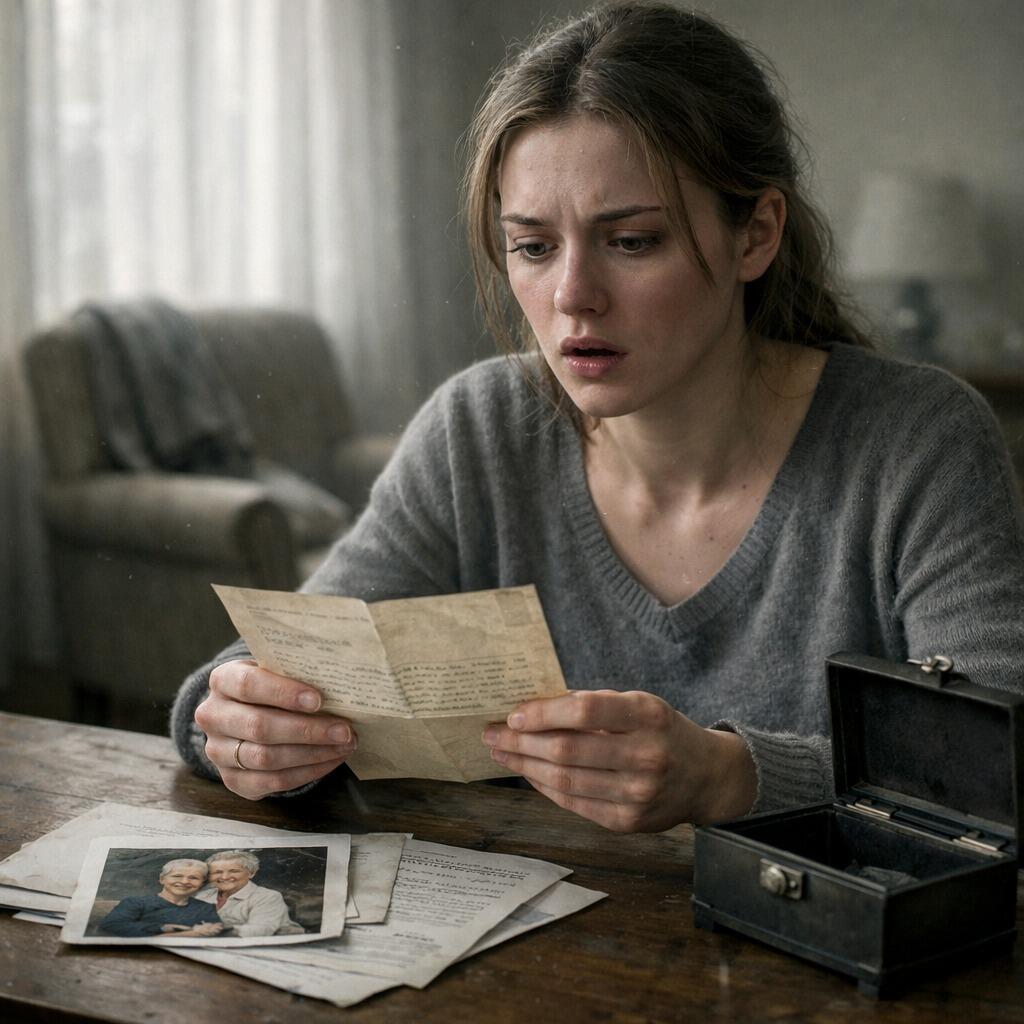
Three days after her funeral, a letter arrived.
My name was written on the envelope in her familiar handwriting.
My hands trembled as I opened it.
Inside was a single letter—and a set of documents.
She wrote:
“My sweet girl,
If you are reading this, I am no longer there to hold your hand. I’m sorry I didn’t tell you everything. I wanted you to have a childhood, not a burden.”
My heart pounded as I kept reading.
She explained that after my parents died, they had left a small life insurance policy. It wasn’t enough to live on forever—but it was enough to change my future if protected carefully.
She had never touched a single dollar of it.
Instead, she lived frugally. She denied herself comforts. She wore old clothes and repaired broken things so that money could grow untouched.
The documents showed it clearly.
The savings she had been protecting my entire life were now mine.
Enough for college.
Enough for a home.
Enough to begin a life without fear.
At the end of the letter, her handwriting grew shakier:
“You asked for a car. I said no because I was saving for something bigger—your freedom. I wanted you to start adulthood without chains. Even if it meant you thought less of me for a while, it was worth it.”
I broke down on the kitchen floor—the same place she once made pancakes for dinner.
All the sacrifices I never noticed.
All the things she went without.
All the love hidden behind quiet choices.
She had raised me not just with affection—but with foresight.
Today, I drive a car. I live in a warm home. I have a future she built with patience and silence.
And every time life feels overwhelming, I remember this:
Love isn’t always loud.
Sometimes, it looks like saying no.
Sometimes, it looks like sacrifice that will only be understood after someone is gone.
My grandmother raised me alone.
And even after her death, she was still protecting me.
Để lại một bình luận