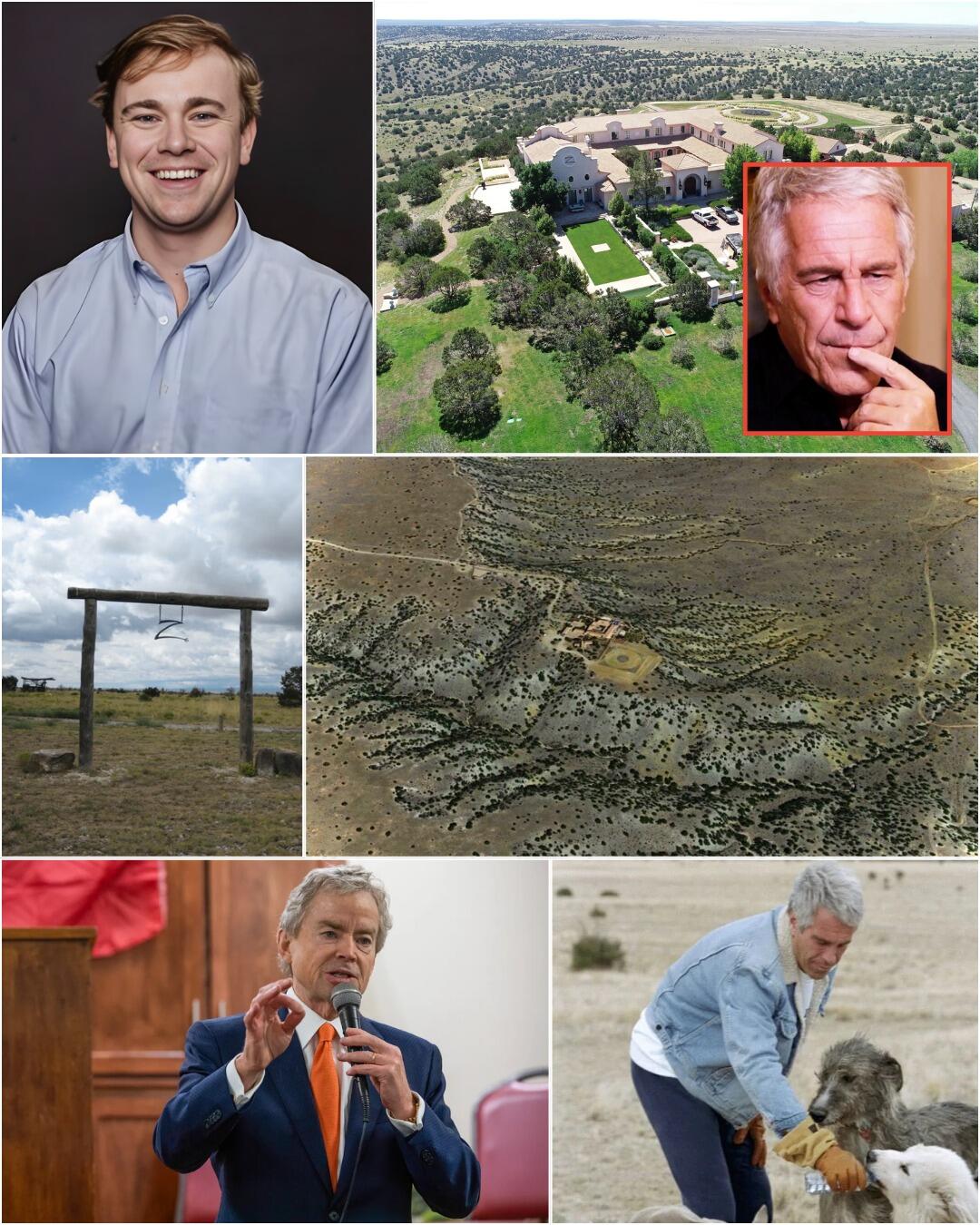
A radio host opened an email in 2019. It said two girls never made it off that property alive. He reported it to authorities. Nobody came.
The ranch sat untouched for six more years.
Thirty miles from Santa Fe. Seven thousand acres of open desert. A private airstrip. A 26,000-square-foot mansion. And somewhere on those grounds, an anonymous sender claimed to know exactly where two young women may still be.
Jeffrey Epstein bought this land in 1993. What happened inside those fences came out slowly — through women who testified in federal court at enormous personal cost.
One said she was brought there as a teenager. Alone in the desert. No way out.
Another described being targeted there, more than once, at that same location.
A third posted a photo from the ranch years later. She was 17 in that picture. She captioned it herself.
The ground was never searched. Not once.
Then in 2023, the ranch quietly sold — a freshly created shell company, price undisclosed, owner hidden. When journalists cracked the records open in February 2026, the name behind that company was Don Huffines — Texas state senator, Republican candidate for Comptroller, currently running for control of hundreds of billions in state funds.
He filed paperwork with the county arguing the ranch was worth less because of its dark history. He used what happened to those women to lower his tax bill.
His spokesman said the family plans to turn it into a Christian retreat. They named it San Rafael Ranch — after the patron saint of healing.
But now the New Mexico Attorney General has reopened the criminal investigation. A Truth Commission launched. And investigators are circling one question nobody has answered in 26 years:
Who in New Mexico’s government protected Epstein on that land — and why has that name never appeared in any public file?
That person may still hold office today.
The Email Nobody Acted On
It is the fall of 2019. Jeffrey Epstein has been dead for less than three months.
In Albuquerque, New Mexico, a conservative radio host named Eddy Aragon opens his inbox. He doesn’t know it yet, but what he is about to read will haunt him for years. The email is anonymous. The sender has no name, no return address, no trail. But the words are specific. Detailed. The kind of detail that stops you cold.
The email claims that the bodies of two young girls are buried on the grounds of Epstein’s New Mexico property — a sprawling, isolated compound 30 miles southeast of Santa Fe known as Zorro Ranch.
Two girls. Buried. On his land.
Aragon doesn’t ignore it. He does what a journalist does — he starts making calls. He contacts local authorities. He forwards the information. He pushes. But nothing happens. The ranch sits undisturbed. The new owners are found, the gates close, and the desert keeps its secrets.
For six years, nobody digs.
Then, in February 2026, the email surfaces publicly. New Mexico’s Land Commissioner holds a press conference. Legislators call for a full investigation. The state attorney general reopens a criminal probe. And the identity of the people who quietly purchased one of the most infamous properties in America is finally revealed.

The buyer? The family of a Texas Republican politician running for state comptroller, who bought the property with a shell company, negotiated the price down by citing the ranch’s “infamy,” and renamed it “San Rafael Ranch” — after the patron saint of healing.
This is the story of Zorro Ranch. It is a story about a predator who operated for decades in the open. About victims who told the truth and weren’t believed. About a property that changed hands in near-total secrecy. And about an anonymous email that sat in a radio host’s inbox for six years while the land it described remained unsearched.
The Man Who Built a Kingdom in the Desert
To understand Zorro Ranch, you have to understand Jeffrey Epstein. Not the tabloid version — the hedge fund manager who hung out with presidents, princes, and tech billionaires. Not the polished, charming dinner guest who could quote Gödel’s incompleteness theorems and discuss quantum mechanics. You have to understand the system he spent forty years building. Because Zorro Ranch wasn’t an accident. It was the crown jewel of that system.
Epstein was born in Brooklyn, New York, in 1953. He grew up in a modest working-class household and dropped out of college. But somewhere along the way, he figured out how to make himself indispensable to powerful people. He became a math teacher at a private New York prep school. He landed a job at Bear Stearns. He cultivated a web of ultra-wealthy clients, and by the 1980s, he was one of the most well-connected financial figures in New York.
He also started buying property. A townhouse in Manhattan — the largest private residence in New York City at the time. A private island in the U.S. Virgin Islands called Little Saint James. A Paris apartment. A ranch in New Mexico.
He bought Zorro Ranch in 1993, purchasing it from New Mexico Governor Bruce King. The price was undisclosed. The deal was quiet. And for the next twenty-six years, until the morning federal agents walked into his New York mansion, Zorro Ranch would serve as Epstein’s most private and most protected hideaway.
A Property Unlike Anything Else
Drive 30 miles southeast of Santa Fe on State Road 41, and you pass through the small town of Stanley. The land here is flat and windswept. Piñon trees and sagebrush. Red dirt. Mountains in the distance. It looks like the rest of rural New Mexico — until you see the fence.
The fence that surrounds Zorro Ranch stretches for miles. Behind it sits a property that locals barely knew existed, even as they drove past it for years.
The main house is a hacienda-style mansion of 26,700 square feet. Twenty-six thousand, seven hundred square feet. That is larger than most luxury hotels. It sits on land that spans somewhere between 7,000 and 10,000 acres, depending on the source — roughly the size of a small city.
The property is entirely self-contained. There is a private airport with a full hangar. A helicopter pad. A 7-car garage. A fire station — not a fire hydrant, an actual station with equipment. Guest houses. An office complex. A heated swimming pool. A gym. Manicured grounds in the middle of the high desert, maintained by a full-time staff that lived on-site.
In short: you could bring people here, and nobody would know. Nobody would hear anything. Nobody would see anything. The nearest neighbor is miles away. The nearest town is small and insular. The land is empty in every direction.
This was by design.
What Happened Inside Those Gates
Here is what we know. Not what is alleged, not what is rumored, but what has been established in federal court, under oath, by women who were there.
Annie Farmer was nineteen years old when she met Jeffrey Epstein. Her older sister Maria Farmer had worked for Epstein in New York and had warned the FBI about him as early as 1996 — a warning that was not acted on. In the spring of 1996, Annie was brought to Zorro Ranch under the pretense of a tutoring and mentorship program. She was a college student. She was told this was an opportunity.
What happened at the ranch was not a tutoring program.
Annie testified at Ghislaine Maxwell’s federal trial in 2021 that she was sexually abused at Zorro Ranch. She was told to remove her clothes. She was massaged without her consent. She was touched by Maxwell in ways that she did not agree to. She was nineteen. She was alone in the New Mexico desert, on a property so isolated that there was no reasonable way to just leave.
She told the jury this. She looked them in the eyes and she described what happened. And the jury believed her.
A woman identified in court only as “Jane” — her real name protected by the court — told a similar story. She was brought to New Mexico. She was abused. She described not just individual assaults but organized abuse — what she called “group” situations that Epstein orchestrated and Maxwell facilitated.
She was a teenager when it started.
Then there is Chauntae Davis. Davis has spoken publicly about what happened to her at Zorro Ranch. She told CBS News in 2019 — the same year Epstein died — that she was raped at the ranch. Not once. At least twice.
She said it clearly. She said it on camera. She said: Zorro Ranch. At least twice.
And Virginia Giuffre — perhaps the most high-profile of Epstein’s accusers, the woman whose civil case against Prince Andrew would eventually result in an out-of-court settlement — posted a photo from Zorro Ranch on her Twitter account years later. She is young in the photo. Very young. Her own caption read: “In New Mexico… I was about 17. End of the day we returned to Epstein’s Zorro Ranch.”
Seventeen. End of the day. Returned.
The language is casual. The horror underneath it is not.
The “Baby Farm” Theory
What Epstein planned for Zorro Ranch went even further than what we know happened there.
In 2019, the New York Times reported a story that shocked even people who thought they had heard everything about Epstein. The Times cited multiple scientists and thinkers who had attended dinners and gatherings where Epstein openly discussed his grand plan: he wanted to use Zorro Ranch as a facility to impregnate women with his DNA.
He called it “improving the human genome.” He spoke in the language of eugenics — the discredited pseudo-science that was used to justify forced sterilizations and, at its extreme, the Holocaust. He talked about genetics. About selecting for intelligence. About the future of the human species.
And his proposed role in that future? He would be the father. Zorro Ranch would be the place. The women would be brought there.
Scientists who heard him say these things were disturbed. Some dismissed it as rich-man fantasy. Others took it seriously. Either way, it gave new meaning to the isolation of the ranch, to the self-contained infrastructure, to the guest houses and the private airstrip.
The Times quoted Epstein describing this vision to multiple people over multiple years. He wasn’t just talking. He was planning.
Để lại một bình luận