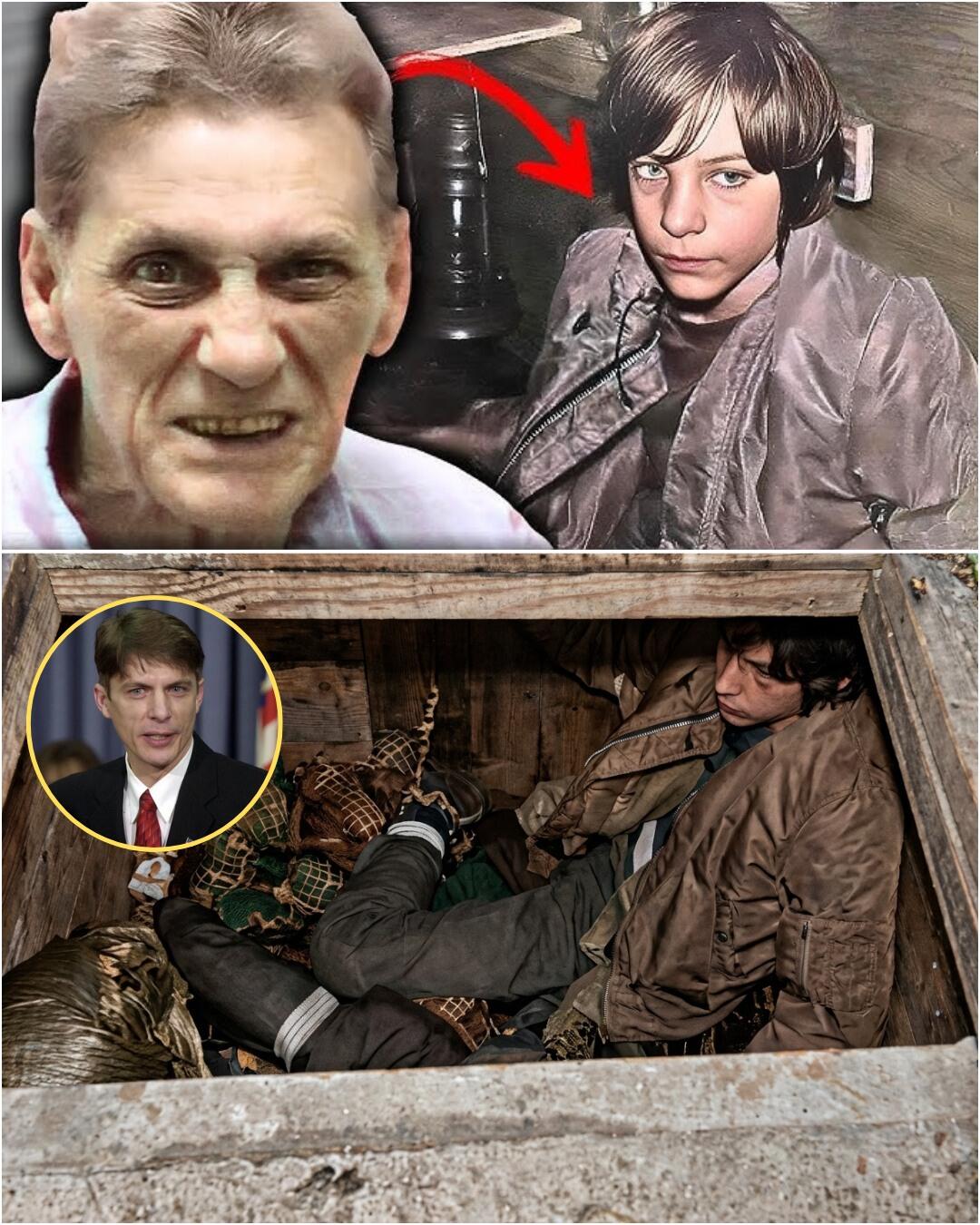

The screams came from beneath the earth.
Two rabbit hunters were inching their way through the frozen woods of Dismal Swamp, in Virginia, on a bitter January morning in 1973 when they heard it—a sound no one ever expects to hear in the middle of the forest. It wasn’t an animal cry. It was human. Desperate. Rising up through snow and frozen soil.
They stopped, listened, and then ran.
Staring back up at them from a cramped wooden box sunk into the earth was a thirteen-year-old boy—filthy, bruised, chained, and very much alive.
His name was Paul Martin Andrews. To family and friends back home in Portsmouth, Virginia, he was just Martin or Marty. Eight days earlier, he had walked out of his house to buy milk for his mother on a snow day.
Everyone thought he had vanished into thin air. No one imagined he was buried in a box in the woods, fighting to stay alive.
A Snow Day That Turned Into a Nightmare
Thursday, January 11, 1973, was the kind of day kids remember for the rest of their lives. A heavy snowstorm had swept across North Carolina and Virginia. Norfolk recorded around nine inches of snow, the heaviest single snowfall in a decade. Schools closed for the second day in a row. Children in Portsmouth spilled out into the streets with borrowed sleds and snowballs, tasting rare winter freedom along the Elizabeth River.
Inside the Andrews family home, things were ordinary. Paul’s mother, Ann, needed milk. The store was only three blocks away. Thirteen-year-old Martin pulled on his coat, told his younger sister Jennifer he’d be right back, and stepped out the door.
He never got there.
As Martin walked along the snow-packed street, a blue Ford van pulled up beside him. The driver, a man in his thirties with a casual manner, leaned across the seat and introduced himself as “Peewee.” He told Martin he needed help moving some furniture at his brother’s place and would pay him for the work. For a boy that age in 1973, the request didn’t sound outrageous. This was a time when kids walked alone, when neighbors asked teenagers to help with odd jobs, and when evil felt farther away.
Martin agreed and got in the van.
The man drove away from the neighborhoods and familiar streets, heading south toward Dismal Swamp State Park—a sprawling wetland area straddling the border between Virginia and North Carolina. Eventually, they turned down an isolated logging road.
A chain blocked their path.
The driver pretended to be annoyed and told Martin they would have to walk the rest of the way. He explained that his brother kept a “deer box” nearby—a buried structure like a hunting blind, where a hunter could store supplies and wait for game without being seen.
They left the van and walked through the quiet woods. Snow weighted down branches. Their breath puffed white in the frigid air. Eventually, they came to a low mound of earth, with a partly concealed metal hatch glinting in the snow. The man lifted the hatch, revealing a plywood box beneath the ground.
He told Martin to climb down and help him bring up some supplies.
The moment Martin’s feet touched the floor of the box, everything changed.
The man’s tone hardened. His face shifted. He pulled a large butcher’s knife and looked at the boy trapped in the cramped space with him.
“I’ve got bad news for you,” he said. “You’ve just been kidnapped.”
Martin’s stomach dropped. A cold, dark realization swept over him: his instincts, those faint flickers of unease on the walk into the woods, had been right all along.
He lunged for the knife, trying to wrestle it away. Before he could grab it, the man who had called himself Peewee drove his fist into Martin’s face, staggering him. In that box, in that moment, the fight shifted entirely. The man had the knife, the strength, and total control. Martin had nothing but fear—and the will to survive.
The Boy Who Vanished
Back in Portsmouth, nobody knew where Martin had gone.
Jennifer waited for her brother to come back with the milk. When he didn’t return, worry crept in. She told their parents. The Andrews family called the police.
The response was immediate and massive. Officers performed grid searches of the area, knocking on doors, questioning neighbors, and looking for anyone who might have seen Martin. One theory suggested he might have fallen into one of the local waterways and drowned; the area was crisscrossed with rivers and canals. The Coast Guard drained a nearby waterway. The fire department sent a helicopter to search from above.
Nothing.
It was as though the boy had vanished from the earth. No witnesses. No vehicle description. No note. No trace.
What nobody knew was that Martin had indeed disappeared from the world—but not in the way they imagined. He hadn’t fallen into water, and he hadn’t run away.
He was alive, beneath their feet, in a wooden box buried in the frozen ground.
Life Inside the Box
The underground box was roughly four feet high, four feet wide, and eight feet long. It was built from plywood and sunk into the earth, with a single metal hatch at the top. It was too low to stand up straight, except directly under the hatch. Most of the time, you could only sit, kneel, or lie down. The air was damp and cold. The walls sweated with moisture. The earth pressed in.
The man calling himself Peewee—whose real name was Richard Alvin Ausley—had built the box himself. He was a carpenter by trade and a predator by choice. He had carefully measured and dug the hole. He had chosen an isolated spot. He had planned the structure to be hidden yet accessible, a place where a child could be kept out of sight and out of reach.
Inside this box, with a knife in his hand and a boy at his mercy, Ausley dropped the last pretense of being a friendly stranger.
For the next eight days, the box became Martin’s world.
He was chained and confined, forced to endure things no child should ever experience. The cramped space left him unable to stretch out fully. The cold seeped into his bones. The darkness made time blur. There was no way to tell day from night except by the faint changes in light seeping through the hatch when it was opened.
Martin’s captor was unpredictable. At times he spoke in a more conversational, almost ordinary tone. At other times he exploded in anger and violence with no warning. He carried the knife constantly, a constant reminder that if Martin did not comply, he could be killed and buried for good.
On some days, Ausley unchained him for short periods and led him out of the box. He made Martin help gather wood, tend the fire, or cook food. They walked together through the wintry woods as if they were simply camping. To an observer who didn’t know what was happening, it might have looked almost normal—a man and a boy outdoors, making a fire in the snow.
But it was never normal. Every moment outside the box existed under the threat of the blade and the promise of punishment. Ausley told Martin explicitly that if he tried to run, he would catch him, hang him from a tree with a chain, and beat him. The message was clear: there was nowhere to go.
Inside the box, Martin’s mind did what minds do when faced with terror they cannot escape. He started breaking time into tiny units: one breath, one minute, one hour at a time. He listened for footsteps overhead. He tried to guess Ausley’s moods. He tried, in small ways, to stay human—thinking of home, of his sister, of his mother at work in the hospital.
He imagined her worry. He imagined her tears. What haunted him most was the thought that she would know he was gone but might never know what had happened to him—that he would simply be a missing child, a name on a list, a photograph on a bulletin board.
Days blurred together into a cycle of fear, cold, confinement, and brief, confusing moments of fresh air and firelight. Martin had no idea how long he had been down there. He just knew he was still alive. And as long as he was alive, no matter how bad it was, there was a chance—just a chance—that someone might find him.
Eight Days Later: Screams in the Snow
On Wednesday, January 19, 1973, exactly eight days after the abduction, Martin found himself alone in the box.
It was bitterly cold outside. Snow still lay thick across the forest floor. Trees stood like skeletal sentries, their branches crusted with ice. The ground was partially frozen.
Ausley left. Martin didn’t know why, or when he would come back—or if he was coming back at all. He didn’t know if the man had left him there to die.
In the quiet of that morning, Martin lay in the dark and thought of his mother again. He wondered if she still believed he was alive. He wondered if she cried herself to sleep. He wondered if anyone would ever know where he had been.
Then, sometime around 8 a.m., he heard it: the sound of engines.
Vehicles. Somewhere not too far away.
A surge of hope jolted through him. He started screaming. He screamed until his throat hurt, until his voice cracked, until he had nothing left but raw sound and desperate will.
Up above, two men out hunting rabbits in the snow were moving through the woods when they heard something they could not explain: screams rising from the ground itself.
They stopped.
They listened.
Then they followed the sound.
As they drew closer, they saw the metal hatch protruding from the dirt. They approached cautiously, guns in hand. What they saw when they opened the hatch was like something out of a nightmare.
A battered, bruised teenage boy, chained inside a makeshift underground cell.
Martin told them he had been kidnapped.
One of the hunters was so overcome with emotion that he had to step away to regain his composure. The other stayed and tried to reassure the boy that he wasn’t going to be left down there anymore.
The hunters called the police. Officers rushed to the scene. Rescue workers used bolt cutters to sever the metal that bound Martin. Crime scene photographs captured his condition—swollen face, blackened eyes, visible injuries. The images were horrifying, but they also provided undeniable evidence of what he had endured.
The Boy Comes Home
The police put Martin in the back of a squad car and drove him straight to Obici Memorial Hospital. He needed medical treatment. He also needed something just as important: his mother.
Ann was on duty as a nurse when they brought him in.
She later recalled how he looked: filthy, exhausted, but oddly excited—to be alive, to be found, to see his family again.
Martin’s younger sister Jennifer saw him later that day. Years afterward, on a television talk show, she described the moment she saw his face.
He turned and looked at her.
In that instant, she said, “the nightmare came true.” His eyes were different—empty, distant. The cheerful, protective older brother she knew was gone. The boy standing in front of her was someone else, someone who had seen things no child should ever see.
The physical injuries would heal with time. The internal scars would not.
Who Was Richard Alvin Ausley?
As the investigation unfolded, the truth about the man who called himself Peewee came into sharp, chilling focus.
Richard Alvin Ausley, born in Virginia in 1939, was not some first-time offender who had suddenly snapped. He was already a seasoned predator.
In 1961, he had abducted a ten-year-old boy from outside a recreation center, taken him to a remote area, and assaulted him. He was convicted of abduction and kidnapping and sentenced to a lengthy prison term—but was released on parole years before his full sentence was completed.
By the time he encountered Martin in 1973, he was also facing new charges involving a fourteen-year-old boy. On the very day he kidnapped Martin, he was scheduled to appear in a Portsmouth courtroom on a sodomy charge. Instead of going to court, he went hunting for another victim.
He was a boatyard worker and a carpenter. He had used those skills to build the underground box in Dismal Swamp, planning every detail: where to put it, how deep to bury it, how to hide it, and how to make sure he could get in and out while keeping a child locked inside.
After Martin identified Ausley as his kidnapper, police arrested him at the home he shared with his father. At trial, Martin was the key witness. He remembered walking into the courtroom and seeing Ausley staring at him, unblinking, throughout his testimony.
Ausley tried to twist reality. In court, he would later claim that what had happened in the box had somehow been consensual—that the child had wanted it, or that the boy bore some responsibility. It was a grotesque inversion of truth, a classic tactic of abusers: blame the victim, rewrite the story.
The jury didn’t buy it.
Ausley was convicted of abduction and other related charges and sentenced to forty-eight years in prison.
For many, that sentence felt like the end of the story. The man who had done this was going away for decades. The boy had survived. Justice, in some form, had been served.
But trauma doesn’t end when a prison door slams shut. And for Martin, the real impact of what had happened would unfold quietly, over years.
Silence That Wounded as Deeply as the Crime
In the 1970s, understanding of child trauma was far less developed than it is today. Professionals often believed the best way for a child to recover from something horrific was to avoid talking about it, as if silence could make memories fade.
Martin’s parents were told by experts that he should not be encouraged to talk about what he had gone through, and that others around him should not bring it up. The idea was that, if he didn’t discuss it, he would eventually forget and move on.
That didn’t happen.
Instead, everyone else moved on.
“The reality,” Martin would later say, “was that everyone forgot about it. Everyone except for me.”
The silence around what had happened became its own kind of prison. Martin learned very quickly that this part of his life—the most violent, life-altering thing he had ever experienced—was unspeakable. There was no safe space to talk about it, no language for what he felt.
He tried to push the memories down. He did his best to act normal, to be the son, brother, and student people expected him to be. On the surface, he was a boy who had survived a terrible ordeal and seemed to be putting it behind him. Inside, he was carrying it alone.
When he reached nineteen, the weight of being “the boy in the box” in his hometown became too much. Martin decided to move to Fort Lauderdale, Florida, where no one knew his story. He wanted a place where he could just be a young man starting a new life—not the kid everyone whispered about or pitied.
Later, he moved again, closer to family in North Carolina, then eventually settled in the Miami area. He worked, made friends, built a life. He tried, in the ways he could, to leave the box in the past.
But trauma has a long memory. It doesn’t vanish just because other people stop talking about it.
A Phone Call That Brought Everything Back
For nearly thirty years, Martin stayed quiet about what had happened to him in Dismal Swamp.
Then, in June 2002, his mother called him with news that shattered that silence.
She had learned that Richard Alvin Ausley—the man who had abducted and imprisoned her son—was going to be eligible for parole after serving thirty years of his forty-eight-year sentence.
“To hear that this man, this man who had done such horrible things to me…this man that I thought would be in prison for the rest of his life, that I would never have to deal with him, was now being released—I was horrified,” Martin said.
All the assumptions he had lived with—that the man was gone, locked away forever, no longer a threat—suddenly collapsed. It wasn’t just about his own safety. It was about every child out there who might cross paths with a man like Ausley.
Ausley had not been a one-time offender. He had a pattern. He had done this before. He had done this to Martin. And if released, there was every reason to believe he could do it again.
By this time, Virginia had passed legislation known as the Civil Commitment of Sexually Violent Predators Act. This law allowed the state to hold the most dangerous sex offenders in a secure treatment facility even after they had completed their prison sentences—if they were still considered a serious threat.
The problem was funding and implementation. The law existed on paper, but it had not fully come to life. Parts of it needed to be rewritten to be constitutionally sound. Resources were needed. Political will was needed.
Martin realized he had a choice.
He could remain silent, as he had been urged to do decades earlier, and hope that someone else would prevent Ausley’s release.
Or he could step forward, open the door to the box in his mind, and tell the world what had happened to him—publicly, on television, in print, in legislative hearings—so that the man who hurt him, and men like him, would not be given another chance to destroy children’s lives.
Silence had protected his abuser before.
Để lại một bình luận